
YOGA
Chest Opener Stretch: Technique, Benefits, and Best Practices


A chest opener stretch is a targeted flexibility exercise designed to lengthen the muscles of the anterior upper body, particularly the pectoralis major, pectoralis minor, and anterior deltoids. These muscle groups play a central role in shoulder positioning and upper-body posture. When they become chronically tight, as is familiar with prolonged sitting, desk work, or device use, they can restrict movement, alter alignment, and contribute to discomfort across the neck, shoulders, and upper back.
Unlike general stretching routines, a chest opener stretch specifically addresses the structural consequences of forward-oriented daily activities. Its primary objective is to restore balance between the front and back of the upper body, improve shoulder mobility, expand the thoracic region, and support a more upright, efficient posture.
Table of Contents
Why Chest Mobility Matters in Daily Movement
Modern movement patterns are heavily biased toward forward motion. Typing, driving, scrolling, and working at a computer all reinforce shoulder protraction and internal rotation. Over time, this habitual positioning can result in adaptive muscle shortening and joint restriction.
Limited chest mobility is commonly associated with:
- Rounded shoulders and forward head posture
- Reduced overhead arm movement
- Increased strain on the cervical and upper thoracic spine
- Shallow breathing patterns due to restricted rib cage expansion
The chest opener stretch counters these adaptations by encouraging shoulder retraction and external rotation. Lengthening shortened tissues allows the upper body to return closer to its natural alignment, reducing compensatory stress on surrounding joints and muscles.
Anatomical Focus of the Chest Opener Stretch
Understanding the muscles involved helps explain why this stretch is effective beyond surface-level flexibility.
Primary Muscles Involved
- Pectoralis Major: A large, powerful muscle responsible for arm adduction and internal rotation. Chronic tightness can pull the shoulders forward and limit shoulder extension.
- Pectoralis Minor: A minor, deeper muscle that attaches to the shoulder blade. When shortened, it contributes significantly to rounded shoulders and reduced scapular mobility.
- Anterior Deltoids: These shoulder muscles assist with forward arm movement and often become overactive relative to the posterior shoulder muscles.
Secondary and Supportive Structures
- Thoracic Spine: Increased chest flexibility supports spinal extension.
- Scapular Stabilizers: Upper-back muscles engage to maintain alignment during the stretch.
How to Perform a Chest Opener Stretch Correctly
A chest opener stretch can be performed in multiple ways, depending on mobility level, environment, and goals. The following methods emphasize controlled movement and proper alignment.
Standing Chest Opener (Corner or Doorway)
- Stand facing a corner or doorway with forearms placed against the surface.
- Keep elbows bent at approximately 90 degrees and shoulders relaxed.
- Step forward slowly, allowing the chest to move ahead of the shoulders.
- Maintain a neutral neck and avoid flaring the rib cage.
- Hold for 20–30 seconds, breathing deeply.
- Repeat 2–3 times.
This variation is particularly effective for individuals who spend long hours seated, as it directly reverses prolonged shoulder protraction.
Seated Chest Opener (Chair-Based)
- Sit upright with feet grounded.
- Interlace fingers behind the back with palms facing inward.
- Gently draw the shoulders back and down while lifting the hands slightly.
- Keep the spine long without overarched the lower back.
- Hold for 20–30 seconds, breathing slowly.
This version emphasizes postural awareness and is suitable for workplace breaks.
Supine Chest Opener (Foam Roller)
- Lie on your back with a foam roller placed lengthwise along the spine.
- Allow the arms to fall open to the sides, palms facing upward.
- Let gravity create the stretch rather than forcing the movement.
- Remain for 30–60 seconds, focusing on relaxed breathing.
This method promotes passive chest opening and thoracic extension, making it useful for recovery-focused sessions.
Best Practices for Safe and Effective Stretching
Prepare the Body First
Light movement, such as arm swings or shoulder circles, increases blood flow and reduces the risk of overstretching cold tissues.
Emphasize Breathing
Slow nasal breathing encourages muscular relaxation and improves rib cage mobility. Exhalation often allows a deeper stretch without added effort.
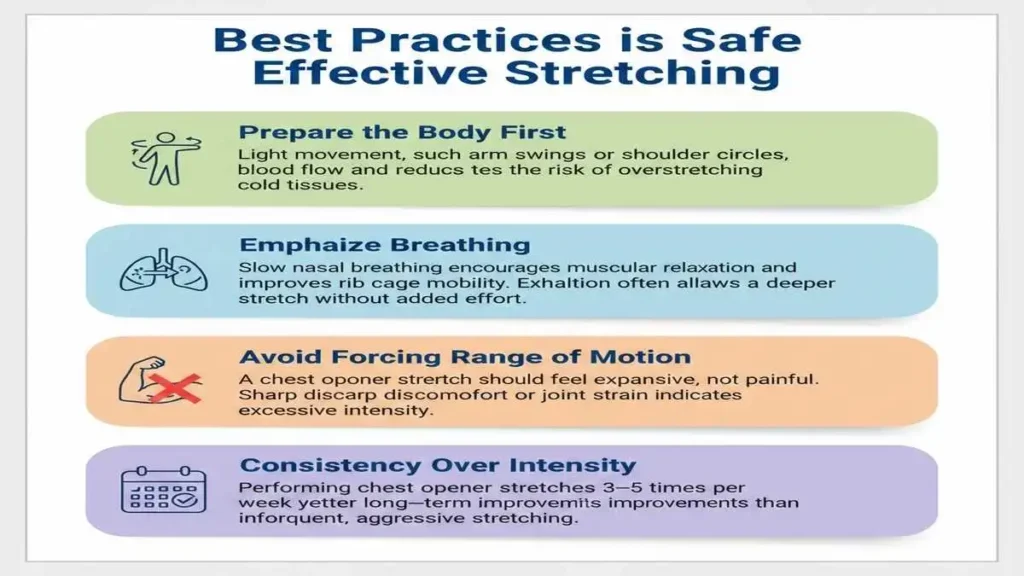
Avoid Forcing Range of Motion
A chest opener stretch should feel expansive, not painful. Sharp discomfort or joint strain indicates excessive intensity.
Consistency Over Intensity
Performing chest opener stretches 3–5 times per week yields better long-term improvements than infrequent, aggressive stretching.
Combine With Strength Training
Stretching alone does not correct postural imbalances. Strengthening the upper back through rowing movements or scapular retraction exercises supports sustainable posture correction.
Common Technique Errors
Even simple stretches can lose effectiveness if performed incorrectly:
- Shoulder Elevation: Shrugging shifts tension away from the chest.
- Lumbar Overextension: Arching the lower back compensates for limited thoracic mobility.
- Rushed Execution: Moving too quickly prevents proper muscle relaxation.
- Breath Holding: Increases tension and limits stretch depth.
Awareness of these errors enhances both safety and effectiveness.
Adaptations for Different Experience Levels
- Beginner: Doorway stretch with minimal forward lean.
- Intermediate: Resistance band chest opener for controlled loading.
- Advanced: Chest opener combined with thoracic rotation to integrate mobility across multiple planes.
Progressions should be gradual and based on comfort, not force.
When Caution Is Required
While generally safe, chest opener stretches should be modified or supervised for individuals with:
- Recent shoulder, chest, or spinal surgery
- Acute rotator cuff or labral injuries
- Joint hypermobility conditions
In such cases, professional guidance ensures appropriate intensity and alignment.
Practical Integration into Daily Life
Chest opener stretches can be applied strategically:
- Morning: To offset stiffness accumulated overnight
- Workday Breaks: To counter prolonged sitting
- Warm-Ups: Before upper-body training
- Cool-Downs: To encourage recovery and relaxation
Short, consistent sessions are more effective than occasional long routines.
Conclusion
The chest opener stretch is a foundational movement for restoring upper-body balance in a posture-challenged world. Addressing muscle tightness, supporting proper alignment, and improving breathing mechanics play a meaningful role in overall movement health. When performed with attention to technique, breathing, and consistency and supported by appropriate strength training, it becomes more than a stretch; it becomes a corrective tool for modern movement habits.


The Benefits of Yoga Meditation for Well-being

Fashionisk.com: Trendy Fashion & Beauty for Modern Women

mststorenet: A Cloud-Based Solution for Streamlining Business Operations

How Much Should You Spend on Wedding Bands?

Chest Opener Stretch: Technique, Benefits, and Best Practices

Why Yoga, Meditation and Mindfulness Are Sweeping Across the Western World

Rajkot Updates News: When Will the Tesla Phone Be Released?

7 Wall Yoga Poses for Deep Stretch

Why Renting a Bike in Cascais Is the Best Way to See the Coast

MyPasoKey: Encryption-Based Password Manager

A Yoga Meditation to Connect to Power – Yoga Meditation Facts and Poses

Why Rocket Yoga Rocks?

Appfordown: Simplify Android App Management

Schedow App: The Future of Smart Time Management

Side Lying Pose, A Relaxing Yoga Pose
-
 GENERAL6 months ago
Christofle – For Those Who Dream of Family Heirloom Silver
-
SPORTS8 months ago
Discover the World of Football with Streameast: Watch Your Favorite Leagues and Tournaments
-
GENERAL6 days ago
Uncovering the World of кинокрадко: The Dark Side of Film Piracy
-
GENERAL3 months ago
ATFBooru: Anime, Gaming, and Subculture Imageboard