YOGA
Yoni Mudra: Benefits, Steps, Meaning & Safety Guide

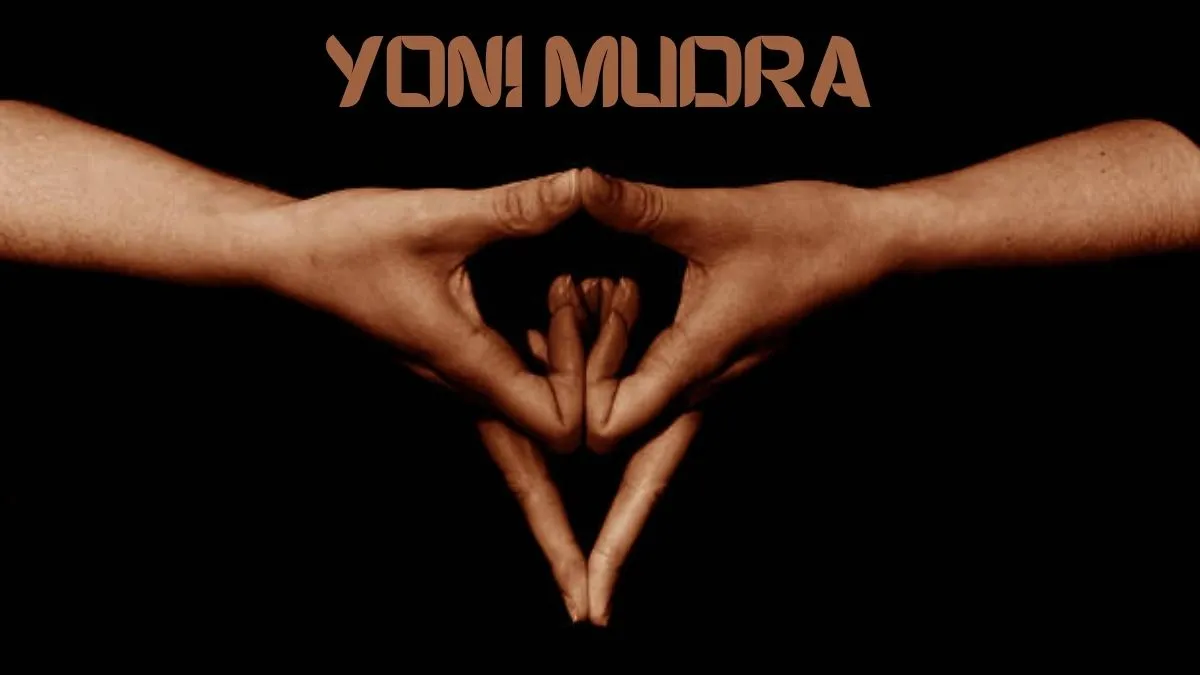
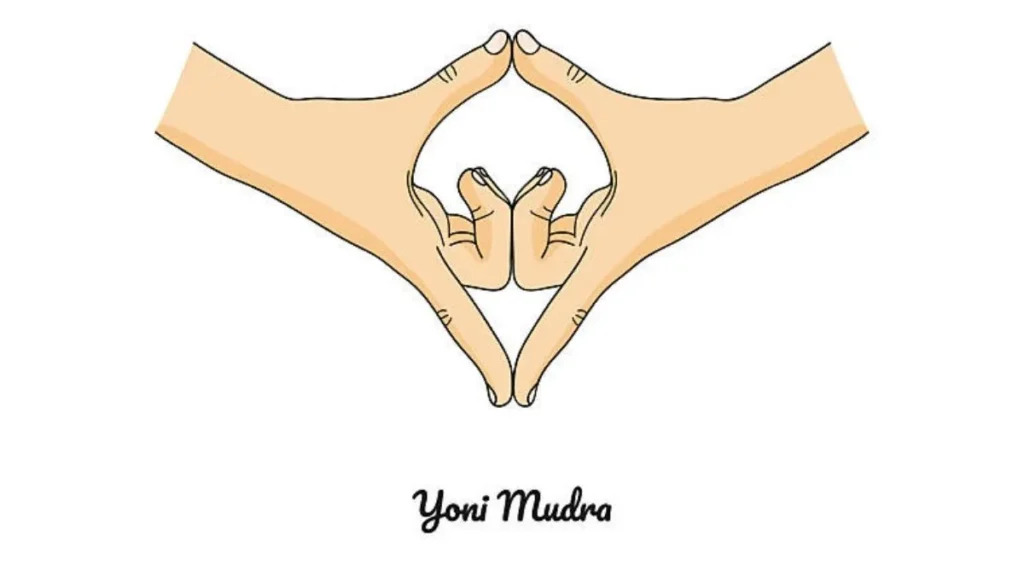
Yoni Mudra is a hand gesture used in yoga and meditation in which the thumbs and index fingers form a downward-facing triangle. In contrast, the remaining fingers are folded or interlaced. The Sanskrit word yoni is commonly translated as “womb,” “source,” or “place of origin,” so the gesture is traditionally associated with inwardness, receptivity, and the source of creation.
Table of Contents
How to Perform the Modern Yoni Mudra
For the commonly taught seated version, aim for a stable hand position without unnecessary muscular effort.
- Sit upright on a cushion, chair, or meditation seat.
- Bring your hands in front of the lower abdomen.
- Extend both index fingers and touch their tips together.
- Touch the two thumbs together.
- Fold the remaining three fingers of each hand inward and interlace them.
- Let the index fingers and thumbs create a downward-facing triangular opening.
- Relax your wrists, shoulders, jaw, and forearms.
- Breathe normally rather than deliberately slowing or holding the breath.
Why Is the Triangle Pointing Downward?
The downward triangle is generally interpreted symbolically rather than anatomically. Because yoni carries associations with origin, the womb, and generative power, yoga traditions have connected the shape with receptivity, inwardness, and Shakti.
This symbolism should not be converted into a biological claim. A triangle made with the hands does not establish a direct physiological pathway to the uterus, ovaries, reproductive hormones, or pelvic organs. If an article claims that the shape itself balances estrogen or improves ovarian function, it has moved from traditional symbolism into a medical claim that requires clinical evidence.
That distinction matters for readers searching for Yoni Mudra because online explanations often mix spiritual vocabulary with promises about fertility and hormonal health.
What Yoni Mudra Actually Does During Meditation
The most defensible way to understand the modern hand gesture is as a physical cue for attention.
Meditation already asks you to perform a repetitive mental task: notice where attention has gone, then return it to the chosen object. A consistent hand position adds a second layer of structure. Instead of repeatedly deciding what to do with your hands, you establish one position and leave it alone.
This does not prove that Yoni Mudra has a unique neurological effect. Research on mudras has examined physiological measures, but the evidence is nowhere near strong enough to establish the therapeutic claims commonly attached to individual mudras. For example, one small study involving 61 participants examined electrophotonic imaging changes associated with mudra practice; such findings cannot establish that Yoni Mudra treats a disease or produces a specific healing effect.
The useful question, therefore, is practical: Does this hand position make your meditation easier to sustain? If you stop fidgeting and return to your breath more consistently, the mudra is serving a useful purpose regardless of whether you interpret it spiritually.
Yoni Mudra Benefits: Separate the Practice from the Claims
Yoni Mudra is frequently advertised for fertility, menstrual regulation, hormonal balance, sexual health, anxiety, and “awakening feminine energy.” These claims belong to different categories and should not be presented as though they have equal evidentiary support.
| Claim | What can reasonably be said |
| Supports a meditation routine | Reasonable practical use |
| Encourages inward attention | Consistent with its traditional purpose |
| Reduces stress by itself | Not established specifically for Yoni Mudra |
| Balances hormones | No established clinical evidence |
| Improves fertility | No established clinical evidence |
| Treats reproductive disorders | Not an evidence-based treatment |
| Has traditional energetic significance | Yes, within yoga frameworks |
Research on yoga is much broader than research on Yoni Mudra. Systematic reviews have found potential benefits from yoga interventions for several psychological and physical outcomes, but they also emphasize substantial differences between interventions and limitations in evidence quality. Those findings cannot simply be transferred to one hand gesture.
That is the evidence boundary a careful practitioner should keep in mind: evidence for yoga is not automatically evidence for Yoni Mudra.
The Classical Yoni Mudra Is Not Necessarily This Hand Gesture
This is the detail most beginner guides leave out.
The Hatha Yoga Pradipika, a major medieval Hatha Yoga text, places mudras within a system concerned with prana, kundalini, bandhas, and internal yogic practice. Its third chapter describes practices involving the perineum, breath retention, bodily locks, and other techniques that are considerably more demanding than sitting quietly with the fingers arranged into a triangle.
Consequently, finding an old text that mentions “yoni mudra” does not automatically validate every modern instruction published under that name.
This also explains why two websites can give radically different Yoni Mudra instructions while both claiming traditional authority. They may be referring to different practices, lineages, translations, or modern adaptations.
Yoni Mudra vs. Shanmukhi Mudra
Confusion between these practices is common because both can be presented as ways to turn attention inward.
| Feature | Yoni Mudra | Shanmukhi Mudra |
| Common modern form | Hands form a downward triangle | Fingers interact with the sensory openings |
| Primary use | Meditation and symbolic inward focus | Sensory withdrawal |
| Physical demand | Low | Higher |
| Basic version requires breath retention? | No | Not necessarily |
| Main beginner issue | Finger and wrist tension | Excessive pressure around the face |
| Common confusion | Classical and modern meanings | Different names across traditions |
If a Yoni Mudra instruction suddenly tells you to manipulate the senses, hold your breath, contract the pelvic floor, or perform complex internal locks, stop and check which tradition or specific technique the instruction describes.
The Mistake of Trying to “Feel Energy”
Beginners sometimes judge a mudra by whether they experience tingling, warmth, pulsing, pressure, or a sensation moving through the body. Those experiences can occur during stillness, changes in breathing, muscle relaxation, or heightened attention, but they are not reliable proof that a particular energetic mechanism has been activated.
A better test is observable and repeatable: after several sessions, ask whether the mudra helps you sit more steadily, fidget less, maintain attention longer, or establish a consistent meditation cue. That gives you a practical measure without requiring you to prove or disprove a spiritual interpretation.
Common Yoni Mudra Mistakes
Forcing the triangle
Your fingers don’t need to be perfectly symmetrical. If your joints are uncomfortable, make a loose version or rest your hands on your thighs.
Practicing with unnecessary breath retention
The basic hand gesture does not require kumbhaka. Adding breath retention because you expect a stronger effect turns a simple meditation aid into a different practice.
Promising reproductive benefits
Yoni symbolism does not constitute evidence of reproductive physiology. Do not use the mudra as a substitute for evaluation or treatment of infertility, menstrual abnormalities, pelvic pain, or hormonal disorders.
Holding it for too long
Ten focused minutes are more useful than thirty distracted minutes spent fighting hand discomfort. Increase duration only when the position remains physically neutral.
A Better 10-Minute Yoni Mudra Practice
Minute 0–2: Sit comfortably and allow the spine to settle without forcing it straight.
Minute 2–3: Form Yoni Mudra. Check that your thumbs, wrists, shoulders, and jaw are relaxed.
Minute 3–8: Follow natural breathing. Do not manipulate your breath. When attention wanders, return to the next inhalation or exhalation.
Minute 8–9: Keep your hands still but shift attention from the fingers to the body as a whole.
Minute 9–10: Release the mudra and notice whether the transition changes your attention or restlessness.
The final minute is useful because it provides a point of comparison. If releasing the mudra makes no noticeable difference after repeated practice, there is no reason to treat the gesture as essential to your meditation.
When Should You Modify or Skip It?
The basic hand gesture places little physical demand on the body, so discomfort in the fingers, wrists, or forearms is the main reason to modify it. Rest the hands on the thighs if maintaining the shape creates strain.
The greater safety issue arises when a teacher or online guide combines “Yoni Mudra” with forceful pranayama, prolonged breath retention, strong bandhas, or other advanced techniques. Those practices deserve separate instruction rather than being casually added to a beginner hand gesture. Research on yoga generally suggests a favorable safety profile when practiced appropriately, but evidence quality and adverse-event reporting remain imperfect.
Frequently Asked Questions
1. Is Yoni Mudra only for women?
No. Its symbolism may draw on feminine and generative imagery, but anyone can practice the modern meditation gesture.
2. Can Yoni Mudra increase fertility?
No established clinical evidence shows that the hand gesture increases fertility. Infertility requires appropriate medical assessment rather than reliance on a mudra.
3. How long should you hold Yoni Mudra?
Start with about 5–10 minutes. No evidence shows that longer is automatically better.
4. Can Yoni Mudra balance hormones?
This is a popular claim, but it is not an established effect of the hand gesture. Do not confuse traditional energetic language with demonstrated endocrine changes.
5. Can you practice Yoni Mudra before sleep?
Yes, particularly if you use it simply as a quiet meditation cue. If sitting meditation makes you more alert rather than relaxed, another evening practice may be more appropriate.
6. Is Yoni Mudra the same in every yoga tradition?
No. The name has been used differently across yoga literature and modern teaching systems. The classical Hatha Yoga context is substantially more complex than the simple hand gesture commonly taught today.





Preparing for Your Child’s First Dental Visit: A Practical Guide for Parents

What to Look for in a Pilates Studio or Instructor

Why Recurrent Cleaning Services Keep Homes Spotless All Year

AI PPT Maker for Teachers: Turn Lesson Notes into Slides That Leave Room to Teach

Chief Technical Examiner: Roles, Rules and Responsibilities

When Should You Visit an Orthopaedic Clinic for a Sports Injury?

How to Choose an E-Bike for a More Active Everyday Lifestyle

What is Chin Mudra? Discover Its Meaning and Health Benefits

Classroom20x: Future of Hybrid Learning Explained

Exploring the World of Futbolear: A Comprehensive Guide

LeahRoseVIP: Trusted Lifestyle Magazine for Holistic Wellbeing

Daily Spine Care: Simple Habits for Less Strain and More Comfortable Movement

Switching 2nd: Understanding the Shift into Second Gear

Hamro Solar LLC: Leading Renewable Energy Solutions

Ausbeulstation: Advanced Automotive Dent Repair
-
 GENERAL1 year ago
Christofle – For Those Who Dream of Family Heirloom Silver
-
GENERAL10 months ago
Uncovering the World of кинокрадко: The Dark Side of Film Piracy
-
SPORTS3 months ago
Discover the World of Football with Streameast: Watch Your Favorite Leagues and Tournaments
-
HOME IMPROVEMENT2 years ago
Spacious and Stylish 300cm Round Rugs: Elegant and Modern Designs for a Chic Home Decor