YOGA
Prasarita Padottanasana: How to Do It Correctly

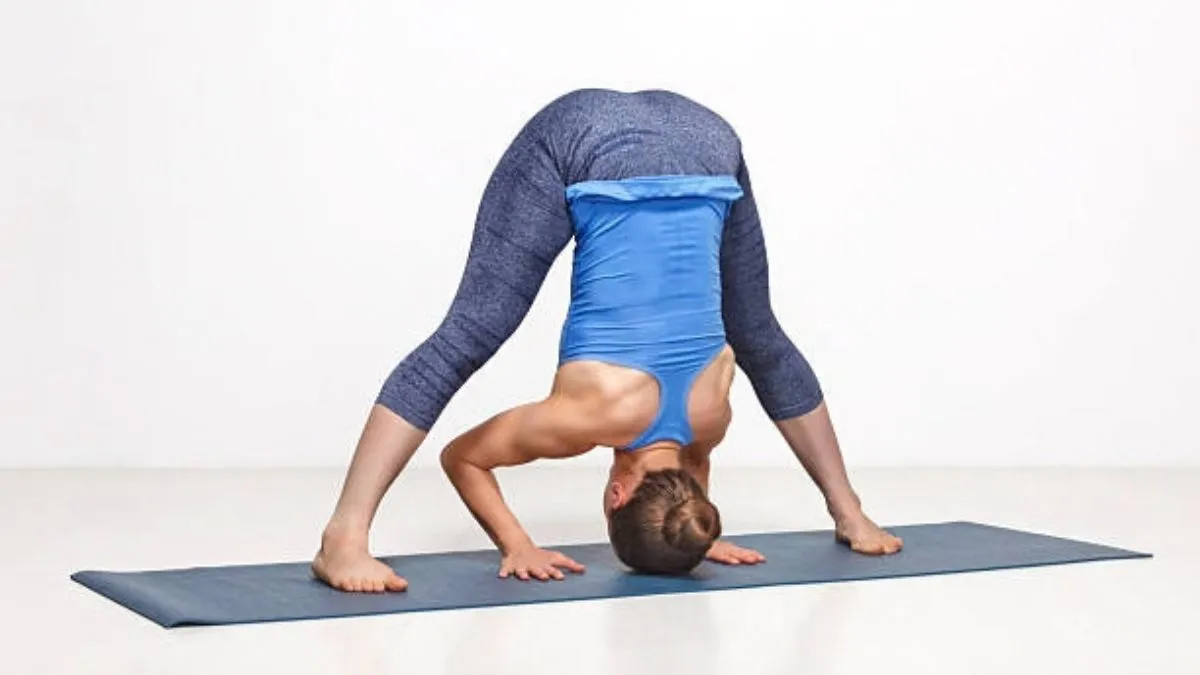
Prasarita Padottanasana is a wide-legged standing forward bend in which the feet create a stable base while the pelvis folds forward over the legs. The pose is often described as a hamstring stretch, but that is only part of what makes it useful: the stance changes how the pelvis can move, while the forward fold demands control of the hips, spine, and lower limbs at the same time.
It is also known as Extended Leg Stretch or Standing Wide-Legged Forward Bend. The pose appears in several yoga traditions with variations in hand position, depth, and whether the head reaches the floor. The deepest version isn’t automatically the most effective; maintaining a controlled hip hinge is usually more useful than forcing the torso downward.
Table of Contents
What Prasarita Padottanasana Actually Trains
The primary movement is hip flexion, not simply spinal flexion. As you fold forward, the pelvis should rotate over the tops of the thigh bones while the legs remain active. The hamstrings lengthen because they cross both the hip and knee joints, while the adductor muscles contribute to controlling the wide-legged position.
The feet provide the foundation for everything above them. If your weight collapses into the heels, the pelvis can drift backward, and the torso may descend by rounding the spine. If you distribute weight through the entire foot, particularly the tripod formed by the heel, base of the big toe, and base of the little toe, the legs can provide a more stable platform for the hip hinge.
This is why touching the floor is a poor test of technique. Someone may reach the floor easily because of spinal flexibility or compensation, while another practitioner may need blocks despite having excellent control of the movement.
How to Find the Right Stance Width
Stand facing the long side of your mat and separate your feet. A practical starting point is approximately 3–4 feet, although your height, hip structure and mobility determine the most useful distance.
Your stance is probably too narrow if you cannot maintain balance or your knees repeatedly move inward. It may be too wide if your inner thighs feel overstretched, your feet become difficult to control, or your pelvis feels trapped between your legs.
The goal is not to find one “correct” measurement. The correct stance is the width at which you can keep both feet active while allowing the pelvis to move freely.
Turn the toes slightly inward or keep them approximately parallel depending on your practice and anatomy. Avoid forcing the feet into an aggressive position simply because another practitioner’s alignment looks different.
Step-by-Step Technique
1. Establish the feet before moving the torso
Press down through the heel, the base of the big toe and the base of the little toe. Spread the toes without gripping them. Activate the thighs so the knees remain supported rather than hanging passively into the joint.
This foot preparation is easy to overlook, but it determines how much control you have when the torso begins to descend.
2. Lengthen before folding
Place your hands on your hips and inhale. Lift through the sternum and lengthen the spine without exaggerating the lower-back curve.
Think of this phase as creating space for the pelvis to move, rather than trying to make the chest look artificially lifted.
3. Hinge from the hips
Exhale and move the pelvis backward as the torso inclines forward. Once the pelvis has reached the limit of comfortable movement, allow the torso to descend further.
If your back immediately rounds, do not interpret that as a command to stretch harder. Raise your hands onto blocks and repeat the movement.
4. Choose the support point
Place your hands on the floor, blocks or another stable support. Your hands should keep your spine and pelvis controlled, rather than forcing you to reach farther than your mobility allows.
A block is therefore not merely a beginner’s accessory. It changes the pose’s geometry by bringing the floor closer to you.
5. Settle without collapsing
Once you reach your working depth, keep your thighs active and the feet grounded. Keep the neck relaxed rather than deliberately pulling your forehead toward the floor.
Take several slow breaths. If your breathing becomes shallow because the abdomen is heavily compressed, reduce the depth.
The Four Prasarita Padottanasana Variations
Prasarita Padottanasana is often practiced as four related variations. They are not simply four different hand positions; each changes the demands placed on the body.
| Variation | Hand position | Main technical demand |
| A | Hands toward the floor | Establishes the basic forward-fold pattern |
| B | Hands on hips | Removes arm support and emphasizes leg and trunk control |
| C | Hands behind the back | Adds a shoulder and chest component |
| D | Hands grasping the big toes | Requires greater hamstring, hip and shoulder control |
The exact naming and sequencing can vary between yoga traditions, so practitioners following a specific school should use that school’s instructions.
The key point is that you shouldn’t progress between variations based solely on how low you can fold. A harder hand position can expose limitations in the shoulders, hamstrings or pelvic control even when the basic forward bend looks easy.
How to Know Whether Your Fold Is Too Deep
Use three checks instead of judging the pose by how close your head is to the floor.
Check 1: Can you breathe normally?
If the abdomen feels compressed enough to restrict breathing, come higher.
Check 2: Are the legs still active?
If the knees lock backward and the thighs stop contributing, reduce the range.
Check 3: Can you identify movements at the hips?
If most of the additional depth comes from rounding the spine, you have moved beyond your useful range.
These checks are more informative than flexibility alone. The goal is not maximum range; it is controlled range.
Prasarita Padottanasana Benefits: What the Pose Actually Develops
Hamstring and adductor mobility
The wide stance places the posterior thighs and inner thighs under a controlled lengthening demand. Because the hamstrings cross both the hip and knee, their position depends on both pelvic movement and knee position.
This explains why simply forcing the knees straight does not necessarily produce a better stretch. The quality of the pelvic movement matters.
Hip-hinge control
The pose provides an opportunity to practice moving the pelvis while keeping the trunk organized. That movement skill transfers conceptually to other activities that require bending from the hips rather than repeatedly flexing the spine.
Active leg stability
The standing position requires the feet, quadriceps and hip musculature to work together. The wide stance increases the importance of controlling the legs independently rather than treating them as one rigid unit.
Awareness of spinal compensation
Perhaps the most useful benefit for beginners is learning to recognize compensation. When hamstring or hip mobility limits the fold, the spine often becomes the easiest place to obtain additional movement.
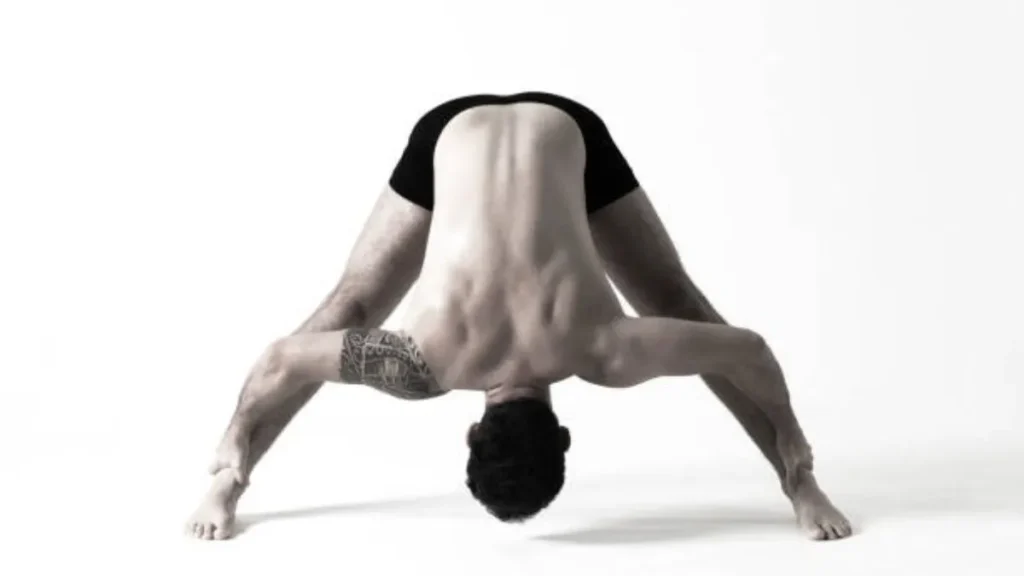
Prasarita Padottanasana makes that compensation visible because the wide stance provides a clear reference for observing the pelvis, legs and torso.
Five Common Mistakes That Change the Pose
1. Chasing the floor
Trying to place the head on the mat can turn a hip-dominant movement into a spine-dominant one.
Correction: Use blocks and stop where the pelvis can still move without forcing spinal flexion.
2. Sitting onto the heels
If the hips travel too far back, the body can lose the stable relationship between the feet and pelvis.
Correction: Re-establish pressure through all three major foot contact points before continuing.
3. Locking the knees
Hyperextending the knees can create the appearance of straight legs without meaningful muscular control.
Correction: Engage the quadriceps while keeping the knees supported rather than pushed backward.
4. Making the stance wider to “get deeper”
A wider stance isn’t automatically better. Excessive width can restrict pelvic movement and increase strain around the inner thighs.
Correction: Narrow the feet until the pelvis can move smoothly.
5. Pulling the head down
The neck should not be treated as the mechanism that creates depth.
Correction: Let gravity assist the fold while keeping the neck passive and the movement initiated from the hips.
How to Modify Prasarita Padottanasana
- For tight hamstrings: Place the hands-on blocks and maintain a longer spine.
- For balance problems: Reduce the stance width slightly and practice near a wall.
- For excessive spinal rounding: Raise the hands higher rather than forcing the torso downward.
- For inner-thigh discomfort: Narrow the stance and reassess foot position.
- For limited shoulder mobility: Choose a variation that does not require the hands to move behind the body or grasp the feet.
The best modification preserves the purpose of the movement, not the one that makes the final shape look most like the full pose.
When Should You Avoid or Modify It?
Sharp pain is not an appropriate target sensation. Use particular caution with existing hamstring, knee, hip, or lower-back injuries because a forward fold can expose limitations that aren’t obvious while standing upright.
People advised avoiding head-down positions should use an appropriately supported variation or seek individualized medical guidance. Never force a yoga posture to match a textbook shape if it aggravates symptoms.
A Better Beginner Progression
Use this sequence:
Find stance → stabilize feet → activate thighs → lengthen spine → hinge hips → use blocks → breathe → gradually increase range.
Do not progress simply because your hands have reached the floor. Progress when you can maintain the same controlled mechanics at a slightly greater range.
A useful test is to come out of the pose, reset your feet and repeat it. If your second attempt produces the same controlled movement without increased discomfort, you are developing repeatable mobility rather than merely forcing a single deep stretch.
The Practical Rule to Remember
Don’t measure Prasarita Padottanasana by how low you go. Measure it by what remains organized while you go there.
Your feet should remain grounded, your thighs active, your pelvis should contribute to the fold, your spine should not be forced into unnecessary range, and your breathing should remain comfortable. Once those elements are consistent, increasing depth becomes a progression in control rather than a competition with the floor.




Prasarita Padottanasana: How to Do It Correctly

Kouskousi: How Traditional Couscous Is Made and Served

When Should You Consider Lower Eyelid Surgery?

What to Look for When Choosing a Memory Care Community

Best IPTV Australia Services in 2026: A Comprehensive Review

Ashtanga Vs Vinyasa Yoga? Which One Should You Choose?

What Is Enhydro? Exploring Water-Filled Fossilized Amber

Unlocking Mamgatoto: The Cultural Phenomenon Shaping Communities Worldwide

DeviceURL in VEX Robotics: Node.js Communication Explained

Navigator Pear: Ornamental Tree Size, Fruit & Care

PeopleTools ATT: The Complete Guide to Oracle’s Application Technology Tools

Understanding Somatic Yoga: How Movement and Breath Can Heal

Discover Puppygirlxd: The Viral Sensation Embracing Pet Play Culture

Quad Equalizer: How 4-Band EQ Actually Works

The Gdp – Deleted Scene – E355: Fan Theories & Insights
-
 GENERAL1 year ago
Christofle – For Those Who Dream of Family Heirloom Silver
-
SPORTS2 months ago
Discover the World of Football with Streameast: Watch Your Favorite Leagues and Tournaments
-
HOME IMPROVEMENT2 years ago
Spacious and Stylish 300cm Round Rugs: Elegant and Modern Designs for a Chic Home Decor
-
GENERAL9 months ago
Uncovering the World of кинокрадко: The Dark Side of Film Piracy