
YOGA
How to Meditate Daily Without Trying to “Empty Your Mind”

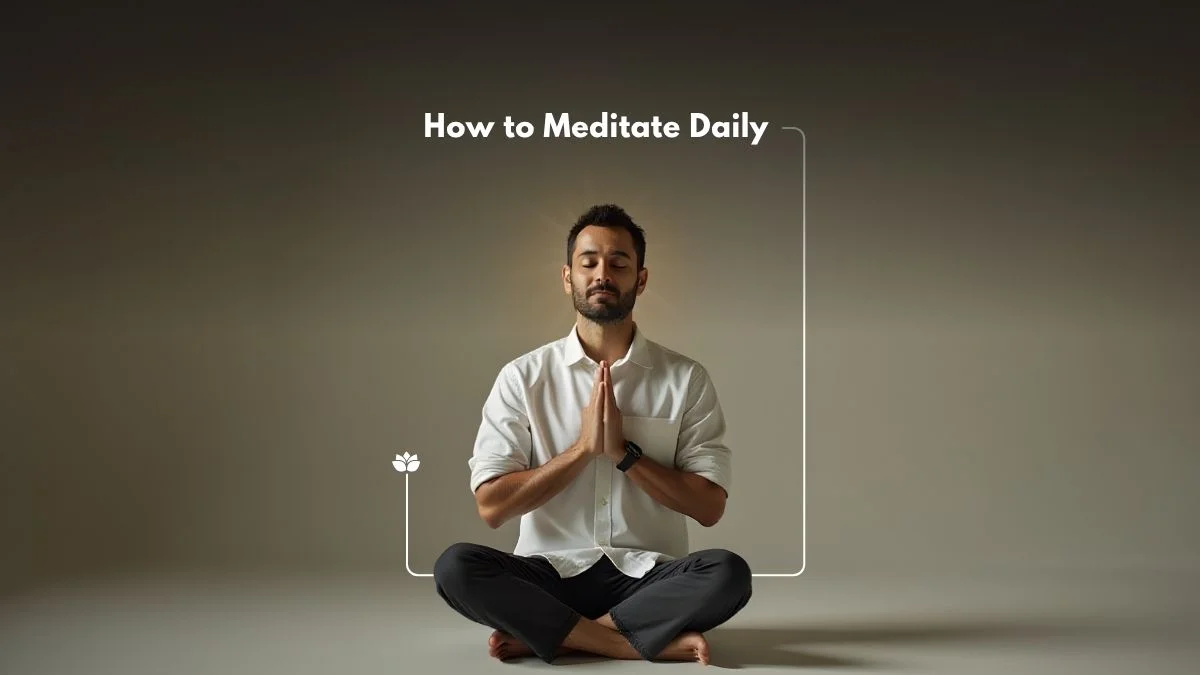
If you sit down to meditate and immediately notice 20 thoughts, you have not failed. You have found the part of meditation you are supposed to train.
Meditation is not primarily about stopping thinking. In mindfulness and focused-attention practices, the skill is noticing where attention went and deliberately bringing it back. That creates a repeatable cycle:
choose an anchor → attention wanders → notice it → return → repeat.
The return is exercise.
Research supports meditation as a useful tool for some forms of anxiety, depression, stress, pain, and sleep problems, although results vary by technique and outcome. A major review of 47 trials found moderate evidence for improvements in anxiety, depression, and pain, but did not find meditation superior to active treatments such as exercise, medication, or behavioral therapies.
That distinction matters: meditate because you want to train attention and awareness, not because you expect every session to make you feel calm.
Table of Contents
How to Start Meditating Daily
Your first routine should be deliberately easy to repeat.
Choose one predictable trigger: after brushing your teeth, before opening your laptop, after morning tea, or right after you get home. The trigger matters more than finding a supposedly perfect meditation hour.
Then:
- Sit somewhere you can remain relatively undisturbed.
- Keep your spine comfortable rather than rigid.
- Set a 5-minute timer.
- Let your breathing remain natural.
- Feel one aspect of the breath, perhaps the air around your nostrils or the movement of your abdomen.
- When you notice thinking, planning, remembering, worrying, or hearing a sound, acknowledge it.
- Return attention to the chosen sensation.
- Stop when the timer ends rather than extend the session because you think longer must be better.
The goal of those five minutes is not relaxation. It is accumulating repetitions of noticing and returning.
Why the Breath Works as an Anchor
Breathing is useful because it requires no equipment and changes continuously. Each inhalation and exhalation gives attention to something specific to detect.
But breathing is not mandatory.
If concentrating on breathing makes you monitor every breath anxiously, switch anchors. Use the feeling of your feet against the floor, sounds in the room, or contact between your hands. Mindfulness practices can use breathing, sounds, bodily sensations, visual objects, or repeated phrases as focal points.
This gives you an important rule:
Choose the anchor that stabilizes attention, not the one that sounds most “meditative.”
What to Do When Your Mind Will Not Stop
Suppose you begin thinking about an exam, an argument, an unpaid bill, or tomorrow’s meeting.
Do not try to defeat the thought.
Instead, mentally label it as planning, remembering, worrying, or simply thinking and return to your anchor.
The label creates a small gap between thought and your reaction. You are not trying to eliminate the thought; you are practicing recognizing when your attention has wandered.
If you must return 40 times within five minutes, that is 40 opportunities to practice the skill.
What If Meditation Makes You Anxious?
This is where generic meditation advice often fails: “Just focus on your breathing” is not appropriate for everyone.
If breath awareness increases anxiety, try this progression:
| What happens | Change the practice |
| Breathing feels uncomfortable | Focus on sounds or your feet |
| You feel trapped with your thoughts | Keep your eyes partially open |
| Sitting increases restlessness | Try slow walking meditation |
| You become very sleepy | Sit upright or meditate earlier |
| You become frustrated | Reduce the session to 2–5 minutes |
| Distressing reactions persist or intensify | Stop and discuss them with a qualified professional |
Meditation is generally considered low risk, but negative experiences do occur. A review cited by the National Centre for Complementary and Integrative Health found negative effects in about 8% of participants, with anxiety and depression among the commonly reported experiences.
Meditation should therefore complement appropriate healthcare, not replace it.
Choose the Technique Based on the Problem
You do not need to practice the same meditation every day.
- For a scattered mind: focused attention on the breath or a sound.
- For physical restlessness: use walking meditation. Give attention to heel contact, weight transfer, and movement rather than forcing yourself to remain still.
- For excessive mental analysis: try a body scan. Move attention through different areas of the body instead of repeatedly evaluating your thoughts.
- For persistent self-criticism: loving-kindness meditation may be more appropriate than repeatedly returning to the breath.
- For falling asleep during meditation: use an upright posture and practice earlier in the day. If your objective is specifically sleep, a relaxation-oriented practice may make more sense than treating meditation as a concentration test.
The right question is not “Which meditation is best?”
It is “Which practice fits what is happening right now?”
Morning or Night: Which Is Better?
Choose based on what you want it to do.
- Morning: useful when you want to practice before emails, social media, conversations, and daily demands consume your attention.
- Midday: useful when you need a deliberate interruption between two parts of the day.
- Evening: useful when your main problem is carrying unfinished mental activity into the night.
However, don’t force nighttime meditation if you consistently fall asleep halfway through. Falling asleep is not necessarily bad, but it means you are no longer training sustained attention.
Consistency beats the theoretically perfect schedule.
How Long Should You Meditate Each Day?
Do not treat meditation duration as a fitness score.
Someone who practices five focused minutes every day can build a stronger habit than someone who tries 30 minutes twice a week and repeatedly quits.
A practical progression is:
- New to meditation: 3–5 minutes
- Comfortable with the routine: 5–10 minutes
- Established habit: 10–20 minutes
- Longer sessions: only if they serve your purpose and remain sustainable
Increase the duration when the existing practice feels repeatable, not because you believe longer sessions automatically produce better results.
The Habit Rule Most Beginners Miss
Never make “I must meditate for 20 minutes” the condition for counting a session.
Create a minimum version instead.
Your normal practice might be 10 minutes. Your minimum might be two minutes. On a busy day, complete the minimum rather than abandoning the habit.
If you miss a day, do not compensate with an unusually long session the next day. Return to your normal routine.
The objective is not a perfect streak. It is reducing the number of times you completely stop.
How to Know Whether Meditation Is Working
Do not judge progress solely by whether you feel peaceful immediately afterwards.
Look for changes outside the meditation session:
- You notice distraction sooner.
- You react less automatically to irritating situations.
- You can return to a task after being interrupted.
- You recognize worry before it becomes an extended mental loop.
- You notice bodily tension earlier.
- You can experience an unpleasant thought without immediately following it.
These indicators matter more than whether every session feels relaxing.
Meditation research also does not justify promising dramatic results for everyone. Evidence is strongest for some outcomes and weaker or mixed for others.
Common Mistakes That Make Daily Meditation Harder
- Changing techniques every few days: You never spend enough time learning one method.
- Trying to suppress thoughts: Thought suppression turns meditation into a fight with your own mind.
- Starting with ambitious sessions: A difficult routine creates unnecessary resistance.
- Judging every session: A restless session can still contain excellent attentional training.
- Using meditation to avoid problems: Awareness can help you respond differently, but it does not eliminate the need to study, communicate, exercise, seek treatment, or solve practical problems.
A Simple Daily Meditation Formula
If you want one routine to start today, use this:
5 minutes → comfortable posture → natural breathing → notice distraction → return → repeat → stop when the timer ends.
After several sessions, do not automatically add more time. First ask:
What is making this practice difficult?
- If the answer is sleepiness, change your timing.
- If it is anxiety, change the anchor.
- If it is boredom, investigate the sensations more precisely.
- If it is restlessness, try walking.
- If it is perfectionism, shorten the session.
That is how to meditate daily in a way that can survive real life: not by forcing yourself into one rigid routine, but by learning how to adjust the practice without abandoning its central skill: noticing where your attention went and intentionally bringing it back.
FAQs
1. Can I meditate for only five minutes a day?
Yes. Five minutes is enough to establish repeatable practice. Increase the duration only when the routine is sustainable.
2. Do I have to close my eyes?
No. Closed eyes can reduce visual distractions, but partially open eyes may feel more comfortable if closing them increases sleepiness or anxiety.
3. Should I meditate when I am very stressed?
You can but choose the technique carefully. If focusing inward makes you more distressed, use external sounds, open-eye awareness, or walking meditation instead.
4. Is meditation supposed to make me feel relaxed?
Not necessarily. Relaxation can occur, but meditation is better understood as attention and awareness training. A session can be successful even when you feel restless.
5. What is the simplest way to meditate daily?
Attach five minutes of meditation to an existing daily habit, use one stable anchor, and measure success by whether you practiced, not by whether your mind stayed quiet.







Preparing for Your Child’s First Dental Visit: A Practical Guide for Parents

What to Look for in a Pilates Studio or Instructor

Why Recurrent Cleaning Services Keep Homes Spotless All Year

AI PPT Maker for Teachers: Turn Lesson Notes into Slides That Leave Room to Teach

Chief Technical Examiner: Roles, Rules and Responsibilities

When Should You Visit an Orthopaedic Clinic for a Sports Injury?

How to Choose an E-Bike for a More Active Everyday Lifestyle

What is Chin Mudra? Discover Its Meaning and Health Benefits

Classroom20x: Future of Hybrid Learning Explained

Exploring the World of Futbolear: A Comprehensive Guide

LeahRoseVIP: Trusted Lifestyle Magazine for Holistic Wellbeing

Daily Spine Care: Simple Habits for Less Strain and More Comfortable Movement

Switching 2nd: Understanding the Shift into Second Gear

Hamro Solar LLC: Leading Renewable Energy Solutions

Ausbeulstation: Advanced Automotive Dent Repair
-
 GENERAL1 year ago
Christofle – For Those Who Dream of Family Heirloom Silver
-
GENERAL10 months ago
Uncovering the World of кинокрадко: The Dark Side of Film Piracy
-
SPORTS3 months ago
Discover the World of Football with Streameast: Watch Your Favorite Leagues and Tournaments
-
HOME IMPROVEMENT2 years ago
Spacious and Stylish 300cm Round Rugs: Elegant and Modern Designs for a Chic Home Decor