
GENERAL
Helonium Explained: Formula, Chemistry, Uses & HeH⁺

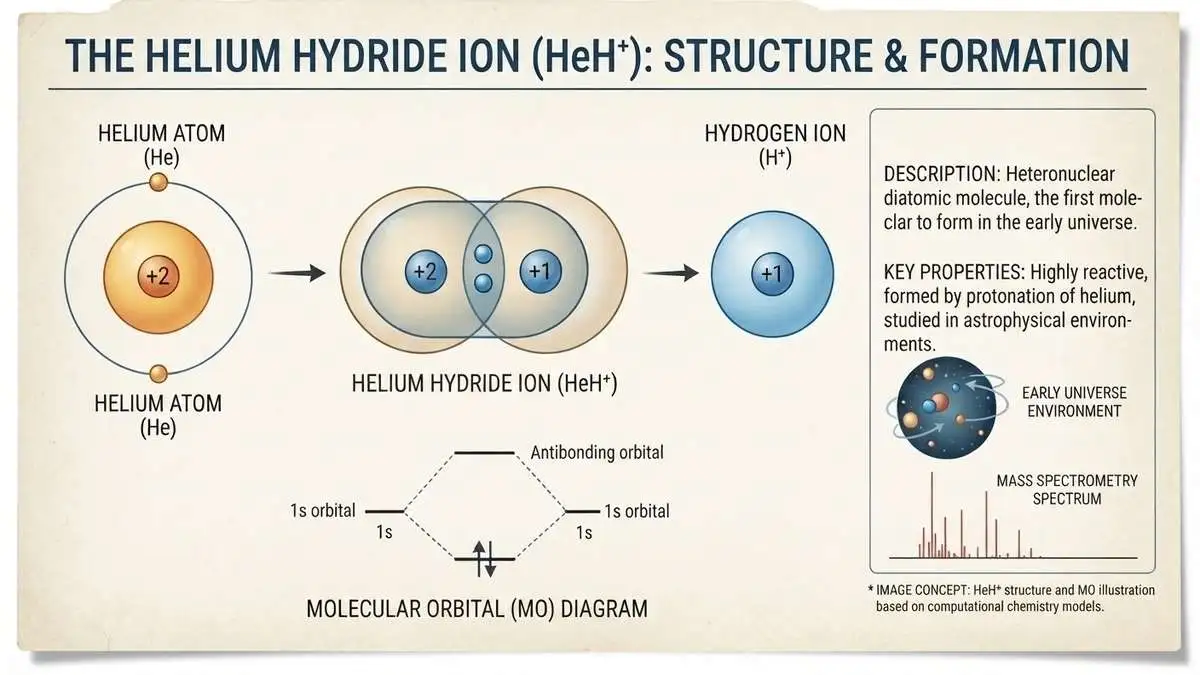
Helonium refers to the helium hydride ion, HeH⁺, a positively charged molecular ion containing helium and hydrogen. It is sometimes written as HHe⁺ in chemical databases; the EMBL-EBI ChEBI database identifies the species as hydridohelium(1+), with a +1 net charge and HeH⁺ as an IUPAC synonym.
The name can be misleading because “helonium” sounds like a chemical element. It is not an element, however, and it does not occupy a position on the periodic table. Helium is the element; helonium describes a molecular ion formed from helium and hydrogen.
| Property | Helonium |
| Chemical formula | HeH⁺ |
| Scientific identity | Helium hydride ion |
| Systematic name | Hydridohelium(1+) |
| Type | Molecular cation |
| Charge | +1 |
| Components | Helium + hydrogen |
| Element? | No |
| ChEBI ID | CHEBI:33688 |
| Average mass | 5.011 u |
The distinction between helium (He) and helonium (HeH⁺) is the first thing to get right. Helium is a neutral noble-gas atom under ordinary conditions, whereas HeH⁺ contains two nuclei and carries a positive charge.
Table of Contents
Helonium Formula: What Does HeH⁺ Mean?
The formula HeH⁺ looks simply, but every part conveys useful chemical information.
- He represents the helium atom.
- H represents hydrogen; in this ion, it is effectively associated with a proton.
- ⁺ indicates that the entire molecular species have a net positive charge.
A useful way to visualize it is protonated helium: a proton interacts with a neutral helium atom to produce HeH⁺. The actual chemistry is more subtle than simply attaching a proton to helium, but this description captures why the ion is classified as a helium hydride cation.
HeH⁺ is also a heteronuclear diatomic molecular ion. “Diatomic” means it contains two atoms, while “heteronuclear” means those atoms belong to different elements.
Is Helonium an Element?
No. No chemical element is called helonium.
An element is defined by the number of protons in its nucleus. Hydrogen has atomic number 1, and helium has atomic number 2. Combining these atoms into HeH⁺ does not create an element with a new atomic number; it creates a molecular species containing nuclei from two existing elements.
This is why the following terms should not be treated as interchangeable:
| Term | What it represents |
| Hydrogen | Element, H |
| Helium | Element, He |
| Hydrogen ion/proton | H⁺ |
| Helium cation | He⁺ |
| Helonium | HeH⁺ |
| Molecular hydrogen | H₂ |
The name itself is therefore a poor guide to identity. The formula and charge are much more reliable than the “-onium” ending.
Why Is HeH⁺ Chemically Unusual?
Helium is famous for being exceptionally reluctant to form ordinary chemical bonds because its electron shell is already filled. That makes HeH⁺ particularly interesting: a species involving helium can exist because the interaction is fundamentally different from simply asking neutral helium to form a conventional stable compound.
The positive charge changes chemistry dramatically. HeH⁺ is highly reactive and can participate in reactions that ultimately transfer hydrogen chemistry into other molecular pathways. In astrophysical environments, its formation and destruction rates matter more than the existence of large quantities of the ion.
Simplified explanations often miss this distinction: HeH⁺ is scientifically important not because it is abundant like helium, but because its reactions can influence chemical networks.
How Does Helonium Form?
One important formation pathway is radiative association, in which a proton and helium interact and the newly formed HeH⁺ releases excess energy as a photon:
He + H⁺ → HeH⁺ + hν
The photon is necessary because the newly formed molecular ion must shed excess energy while conserving energy and momentum. In the early Universe, this reaction became possible as the primordial plasma cooled and neutral helium began to form.
The 2019 Nature detection paper explains that, during the early Universe’s transition from an ionized to a more neutral state, helium recombined before hydrogen because of its higher ionization potential. Neutral helium could then participate in forming HeH⁺ through radiative association with protons.
HeH⁺ and the Early Universe
HeH⁺ matters far beyond its unusual chemistry because it is closely connected with the first stages of molecular chemistry in the Universe.
As the young Universe cooled below roughly 4,000 K, helium ions recombined to form neutral helium. Hydrogen recombination followed. In this low-density, metal-free environment, helium and protons could form HeH⁺, providing an early molecular pathway. The subsequent destruction of HeH⁺ helped open a route toward molecular hydrogen chemistry.
This does not mean scientists have established that every first molecule in the Universe was HeH⁺ in the same sense. More precisely, astrophysical literature regards HeH as the first molecular bond formed during the Universe’s chemical evolution and an important precursor in early molecular chemistry.
That wording matters because “first molecule” and “first molecular bond” are sometimes used too casually in popular science.

When Was Helonium Discovered?
HeH⁺ has a much longer scientific history than its modern astronomical fame suggests.
The ion was first discovered experimentally in 1925, when T. R. Hogness and E. G. Lunn investigated positive ions produced in hydrogen–helium systems. The 2019 Nature paper cites their work as the ion’s first laboratory discovery.
The major mystery was not whether HeH⁺ could exist in a laboratory. The challenge was finding convincing evidence that it existed naturally in space.
That distinction remained important for decades because astronomical detection requires both sufficient abundance and a spectral transition that can be separated from other signals.
The 2019 Astronomical Detection of HeH⁺
Astronomers finally reported the first confirmed detection of HeH⁺ in space in 2019, observing the planetary nebula NGC 7027. The research team detected the ion’s rotational ground-state transition at approximately 149.1 micrometres using the GREAT instrument aboard NASA’s airborne SOFIA observatory.
The choice of instrument was crucial. Earth’s atmosphere strongly absorbs the relevant far-infrared/terahertz radiation, making the transition difficult or impossible to observe effectively from the ground. SOFIA’s high-altitude operation provided access to the required spectral window.
This is a useful lesson in spectroscopy: detecting a molecule is not simply a matter of knowing its formula. Researchers need a characteristic transition at an observable wavelength or frequency, sufficient signal, and an observing environment where atmospheric interference does not overwhelm it.
Why Is Helonium Important in Astronomy?
HeH⁺ provides a way to test astrochemical models describing how simple molecules form and disappear from ionized gases.
Its detection in NGC 7027 also gives astronomers a real astrophysical environment in which to compare theoretical reaction rates with observations. The 2019 study specifically noted that observation constrains chemical networks involving processes such as radiative association and dissociative recombination.
The ion is therefore valuable as a chemical tracer and model-testing species, rather than as a practical material.
Helonium vs. Helium: The Key Difference
| Feature | Helium | Helonium |
| Formula | He | HeH⁺ |
| Classification | Element | Molecular ion |
| Charge | 0 | +1 |
| Contains hydrogen? | No | Yes |
| Atomic number | 2 | None |
| Periodic-table entry | Yes | No |
| Main scientific context | Noble-gas chemistry, physics, industry | Molecular physics and astrophysics |
The easiest memory trick is simple: helium is an element; helonium is HeH⁺.
Common Misconceptions About Helonium
“Helonium is a newly discovered element.”
Incorrect. HeH⁺ is a known molecular ion, not a periodic-table element.
“Helonium is just another name for helium.”
Incorrect. Helium is He; helonium refers to HeH⁺.
“Helonium is a gas that can be stored like helium.”
That is misleading. HeH⁺ is an extremely reactive molecular ion encountered in specialized laboratory and astrophysical environments, not everyday bottled gas.
“The 2019 discovery created HeH⁺.”
No. Scientists produced the ion in the laboratory nearly a century earlier. The 2019 breakthrough was its confirmed detection in astronomical observations.
FAQs
1. What does helonium mean?
Helonium refers to the helium hydride ion, HeH⁺, a positively charged molecular ion containing helium and hydrogen.
2. What is the chemical formula of helonium?
Its formula is HeH⁺. ChEBI records the species as hydridohelium(1+) with a net charge of +1.
3. Is helonium a chemical element?
No. Helonium is a molecular ion and has no independent atomic number or position on the periodic table.
4. Is helonium the same as helium?
No. Helium is the neutral element He, while helonium is the charged molecular ion HeH⁺.
5. When was HeH⁺ discovered?
HeH⁺ was first identified experimentally in 1925.
6. When was helonium detected in space?
The first confirmed astronomical detection was reported in 2019 in the planetary nebula NGC 7027.
7. Why is HeH⁺ important?
HeH⁺ is important because its formation and destruction are connected to the development of molecular chemistry in the early Universe and because astronomical observations can test models of chemical reactions in ionized astrophysical environments.
8. What is the systematic name for helonium?
ChEBI records the systematic name as hydridohelium(1+). ChEBI also lists HeH⁺ and helium hydride ion among its terminology for the species.
Authoritative References


Helonium Explained: Formula, Chemistry, Uses & HeH⁺

Acamento: The Artful Science of Finishing with Purpose

Aura Farming: The Viral Slang Shaping Digital Identity

SoSoActive: Lifestyle & Culture for Millennials & Gen Z

Prasarita Padottanasana: How to Do It Correctly

From Webinar Recordings to Social Clips with Video Cutter AI

A Little Room to Breathe: Making Quieter AI Videos with Wan 3.0

Kouskousi: How Traditional Couscous Is Made and Served

When Should You Consider Lower Eyelid Surgery?

What to Look for When Choosing a Memory Care Community

Best IPTV Australia Services in 2026: A Comprehensive Review

Ashtanga Vs Vinyasa Yoga? Which One Should You Choose?

What Is Enhydro? Exploring Water-Filled Fossilized Amber

Unlocking Mamgatoto: The Cultural Phenomenon Shaping Communities Worldwide

DeviceURL in VEX Robotics: Node.js Communication Explained
-
 GENERAL1 year ago
Christofle – For Those Who Dream of Family Heirloom Silver
-
SPORTS2 months ago
Discover the World of Football with Streameast: Watch Your Favorite Leagues and Tournaments
-
HOME IMPROVEMENT2 years ago
Spacious and Stylish 300cm Round Rugs: Elegant and Modern Designs for a Chic Home Decor
-
GENERAL9 months ago
Uncovering the World of кинокрадко: The Dark Side of Film Piracy