GENERAL
Artificial Zoo: How Technology Creates Digital Wildlife

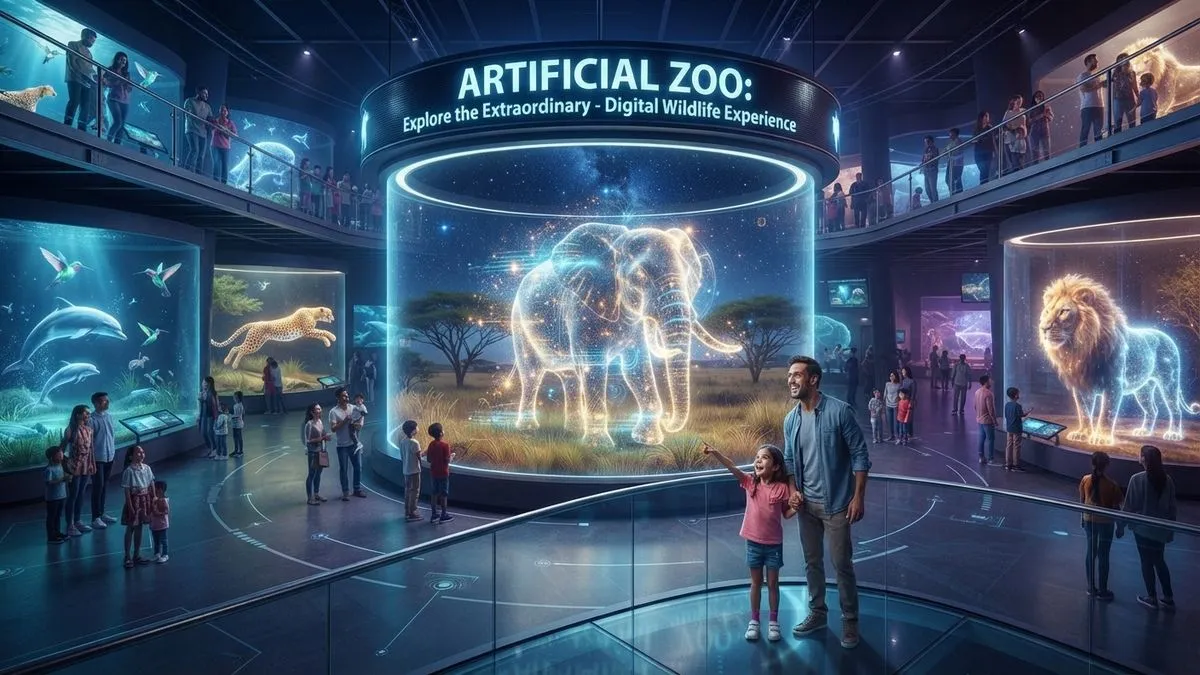
An artificial zoo is a wildlife attraction or educational exhibit that represents animals without relying on living specimens. The representation may be digital, mechanical, projected, virtual, or physical.
The phrase is sometimes used loosely, so five different systems should not be treated as interchangeable:
| Type | What creates the animal? | What the visitor experiences |
| Holographic zoo | Light, projection and tracking systems | Life-sized digital animals in physical space |
| Robotic zoo | Motors, actuators, sensors and artificial skins | Physical animals that move and make sounds |
| VR zoo | Computer-generated 3D environments | A fully digital wildlife environment through a headset |
| AR zoo | Digital objects layered onto the real environment | Virtual animals appearing within the visitor’s surroundings |
| Model zoo | Sculpted or reconstructed specimens | Static physical representations |
This classification solves a common problem with the term artificial zoo: a visitor expecting holograms could instead encounter animatronic dinosaurs, while someone searching for a virtual reality wildlife experience might find a conventional museum exhibit.
Table of Contents
The Most Interesting Example: A Hologram Zoo
One of the clearest real-world examples is Hologram Zoo, developed by Axiom Holographics in Australia.
The attraction does not put a digital animal inside a conventional computer monitor. Its systems are designed to make animals appear within large physical environments. Axiom describes its zoo experiences as using laser-light technology, with tunnels, holographic enclosures and overhead displays forming different parts of the attraction.
An important technical detail: calling the experience a “hologram” should not be interpreted as meaning a solid three-dimensional animal is literally floating in mid-air. The visual effect depends on projection/display technology, optics, tracking and computer-generated imagery. A technical report on the Brisbane installation describes multi-viewpoint 3D display, position tracking and rendering that produces different views for observers.
That distinction is useful because the visual illusion is real, but the animal is not a physical object.
How Does an Artificial Zoo Create the Illusion of Wildlife?
The convincing part of an artificial zoo comes from combining several systems rather than relying on one “hologram” technology.
A typical immersive installation needs:
- 3D animal content: the animal must be modeled, textured and animated.
- Rendering hardware: computers generate the required images in real time or from prepared sequences.
- Display or projection hardware: the imagery must be presented at sufficient scale and brightness.
- Tracking: some systems monitor visitor position so perspective changes correctly.
- Audio: animal calls, environmental sounds and directional effects reinforce the visual scene.
- Environmental design: darkness, walls, tunnels, scenery and lighting hide technological limitations and establish context.
Axiom’s Hologram Zoo materials, for example, describe tunnel environments, fenced holographic enclosures and a ceiling-style display as separate components of the attraction.
The lesson is important: an artificial zoo is an integrated experience, not simply a collection of animated animal files.
Why Tracking Matters More Than Most Visitors Realize
Suppose a digital tiger appears to stand two metres in front of you.
If you move sideways and the tiger remains visually locked to the wrong perspective, your brain immediately recognizes the illusion. The experience becomes a screen showing a picture rather than an animal occupying space.
Tracking helps solve this problem by determining where the viewer is relative to the display and adjusting the visual information accordingly. Technical descriptions of holographic zoo systems have reported position tracking and different rendered views for different viewing positions.
This is one reason an artificial zoo can feel much more convincing in person than the same experience looks in a promotional video.
Artificial Zoo vs Traditional Zoo: The Important Difference
The obvious comparison is “fake animal versus real animal,” but that is too simplistic.
A traditional zoo gives visitors access to a living biological system. The animal may ignore visitors, sleep, interact with another animal, respond to its environment, or behave unexpectedly.
An artificial zoo gives the operator control over the experience.
That creates a fundamental trade-off:
| Question | Artificial zoo | Living-animal Zoo |
| Can the animal appear exactly when required? | Usually yes | No |
| Can extinct species be shown? | Yes | No |
| Can dangerous behavior be simulated safely? | Yes | Limited |
| Is behavior biologically authentic? | No; it is programmed/simulated | Yes |
| Can anatomy be exaggerated for teaching? | Easily | Not without interpretation/modeling |
| Does the exhibit involve animal husbandry? | Usually no | Yes |
| Can visitors observe unpredictable behavior? | Limited | Yes |
The surprising advantage of an artificial animal is therefore control, not realism.
A digital whale can be programmed to pass the audience at exactly the moment an explanation of whale anatomy begins. A real whale cannot be instructed to cooperate with the lesson.
The “Realism” Trap
A common mistake is to ask whether an artificial animal looks real enough.
That is only the first level of evaluation.
Think of simulation fidelity in four layers:
Appearance → movement → behavior → ecology
A digital tiger may have extremely realistic fur and muscle movement. That does not mean its hunting behavior is accurate. Even accurate hunting behavior does not mean the simulation represents the tiger’s relationship with prey, territory, climate, disease, or other species.
This is where an artificial zoo can accidentally become misleading. Visual realism can create an impression of scientific accuracy that the underlying simulation has not earned.
For education, the best exhibits make that distinction explicit rather than pretending that a programmed animal is equivalent to observing wildlife.
What Can an Artificial Zoo Show That a Normal Zoo Cannot?
The strongest applications are situations where physical animals are impossible, inappropriate, or insufficient.
Extinct animals
A digital environment can reconstruct dinosaurs or other extinct species from fossil evidence and scientific interpretation. Visitors can see an entire reconstructed scene rather than a static skeleton.
The limitation is that reconstruction necessarily involves uncertainty. Soft tissues, colors, sounds and behavior may not be completely known, so a responsible exhibit should distinguish fossil evidence from scientific reconstruction.
Impossible viewpoints
An artificial animal can be enlarged dramatically, allowing visitors to examine anatomy or movement that would normally be impossible to observe at close range.
The same principle works in reverse: an exhibit can shrink the visitor’s perspective and create an immersive representation of microscopic or otherwise inaccessible biological processes.
Dangerous encounters
A simulated predator can charge toward visitors without the physical risk of putting people near a real predator.
The educational opportunity is not merely entertainment. The system can pause, replay and explain the behavior immediately afterward.
What About Animal Welfare?
Artificial zoos remove the need to keep a living animal solely for that particular display. That can be significant for attractions whose primary purpose is immersive entertainment.
But “animal-free” does not automatically mean “educationally superior.”
The Association of Zoos and Aquariums has discussed VR and mixed reality as tools that can support engagement and education in zoos and aquariums, while also recognizing whether immersive technology strengthens or distracts from those institutions’ existing missions.
The better question is therefore:
What does the technology allow visitors to understand that they could not understand as effectively through another method?
If the answer is only “the animal looks impressive,” the exhibit is primarily spectacle. If the system connects the animal to anatomy, habitat, behavior and conservation decisions, it has considerably greater educational potential.
Artificial Zoo Technology Is Becoming More Than a Novelty
Technology is no longer limited to one experimental attraction.
Axiom reported in 2026 that its Hologram Zoo network had expanded its library content to nine experiences by June and that new installations had opened in locations including Vancouver and Paris.
That development changes the question surrounding artificial zoos. The issue is no longer simply whether people will watch digital animals. The more interesting question is how much of a wildlife experience can you reproduce without the animal itself.
The answer depends on what “experience” means.
Sight can be simulated extremely well. Sound can be recorded. Movement can be animated. Habitat can be reconstructed. Interaction can be programmed.
What remains difficult to reproduce is the biological unpredictability of a living organism.
When Should You Choose an Artificial Zoo?
An artificial zoo makes the most sense when the objective involves:
- extinct or inaccessible species;
- immersive habitat reconstruction;
- controlled educational demonstrations;
- large-scale anatomical visualization;
- safe encounters with dangerous wildlife;
- repeatable interactive storytelling.
A conventional zoo is fundamentally different when the objective is observing living organisms, natural behavioral variation, animal care, breeding programs, or veterinary practice.
Neither format provides everything the other provides.
How to Judge an Artificial Zoo Before Visiting
Do not judge the attraction solely from photographs. Ask five questions:
What technology is being used? A holographic projection, VR headset and animatronic animal provide very different experiences.
Are animals interactive? Some experiences are predetermined sequences; others respond to visitor position or interaction.
Is there scientific interpretation? Look for information about habitat, anatomy, behavior and conservation rather than only dramatic visuals.
How much of the experience is repeatable? A programmed sequence may produce the same behavior every time, which is useful for teaching but different from observing a living animal.
Does technology serve the story? The best artificial exhibits use technology to reveal something about wildlife rather than using wildlife merely as decoration for technology.
FAQs
1. Are hologram zoo animals actually holograms?
The terminology is not always technically precise. Commercial attractions may call their systems holograms, while technical descriptions can involve projection, multi-viewpoint displays, tracking and computer-generated imagery.
2. Can an artificial zoo replace a traditional zoo?
It can replace some functions of an animal exhibit, particularly controlled visualization and immersive education. It cannot reproduce the experience of observing an independent living organism.
3. What is the biggest limitation of artificial wildlife?
The biggest limitation is not necessarily image quality. It is biological authenticity. A simulation can reproduce what an animal looks like and program how it behaves, but it does not become the animal it represents.
Where is technology heading?
Current development suggests greater content variety, more immersive environments and expansion into new locations. Axiom reported new Hologram Zoo installations and additional experiences during 2026.
The defining question for the next generation of artificial zoos will therefore not be whether digital animals can look real. It will be whether technology can turn that realism into accurate, meaningful understanding of wildlife.


Artificial Zoo: How Technology Creates Digital Wildlife

Kidney Stones and Urinary Problems: Understanding CT Urinary Tract Imaging

Yoga for Anxiety: Poses, Breathing & Expert Tips

Dougahozonn: The Japanese Concept of Video Preservation

Viltnemnda: Managing Norway’s Wildlife Sustainably

Hitaar: A Cultural Art Form of Storytelling and Melody

What Is Drop MMS? Multimedia Messaging Simplified

What is a Rebar Locator? Understanding Non-Destructive Testing (NDT) for Reinforced Concrete

Humanilex: Revolutionizing Human-Computer Interaction

MyLawyer360: Your Comprehensive Legal Resource and Assistance Platform

How Innocams Revolutionizes Home Security: Everything You Need to Know

Cursed-Memes.com: Where Disturbing Meets Funny in Meme Form

TweakLoad Software: Master Weight & Balance Simulation

Diamondfairybunny: Unveiling the Myth and Magic

Lizard Pose: A Complete Guide to Form & Flexibility
-
 GENERAL1 year ago
Christofle – For Those Who Dream of Family Heirloom Silver
-
SPORTS1 month ago
Discover the World of Football with Streameast: Watch Your Favorite Leagues and Tournaments
-
HOME IMPROVEMENT1 year ago
Spacious and Stylish 300cm Round Rugs: Elegant and Modern Designs for a Chic Home Decor
-
GENERAL9 months ago
Uncovering the World of кинокрадко: The Dark Side of Film Piracy