
GENERAL
ABS Testauslösung: Expert ABS System Testing Guide

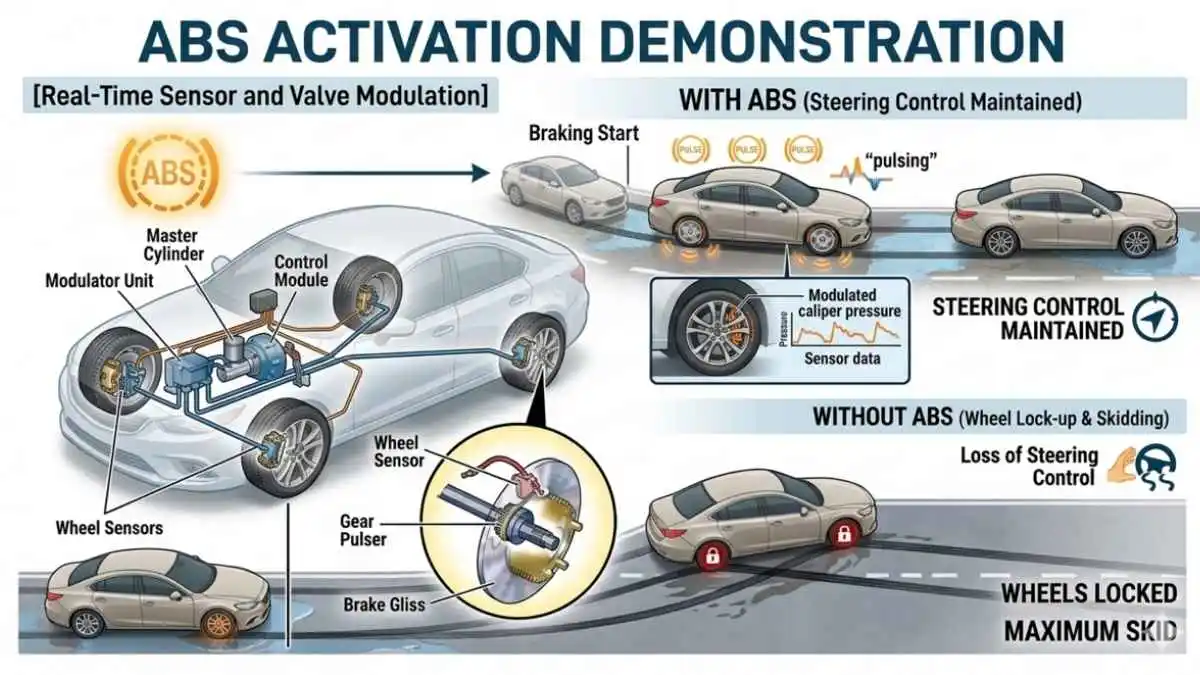
A vehicle can show zero ABS fault codes and still fail under emergency braking.
This is not theoretical; it happens in real workshops every day.
The reason is simple: most failures in modern braking systems are dynamic rather than static. They only appear when the system is under load, cycling valves, and actively managing pressure.
That’s where ABS Testauslösung becomes indispensable.
This isn’t just a test; it’s a controlled stress simulation of the braking system, exposing failures that traditional diagnostics will never detect.
Table of Contents
What Is ABS Testauslösung (ABS Activation)?
ABS Testauslösung refers to intentionally activating the ABS using diagnostic tools or under controlled conditions. Unlike real-world braking, this process is:
- Controlled
- Repeatable
- Data-rich
The goal is simple: verify that the ABS can actively modulate brake pressure under command, not just respond passively to wheel slip.
Why This Matters
Modern ABS systems are not just safety features; they are central control nodes in:
- Electronic Stability Control (ESC)
- Traction Control Systems (TCS)
- Advanced Driver Assistance Systems (ADAS)
If ABS fails, these systems degrade or shut down entirely.
How ABS Actually Works
To understand ABS Testauslösung, you need to look deeper than “prevents wheel lock.”
Core Components Involved
1. Wheel Speed Sensors (WSS)
- Measure rotational speed with high-frequency signals
- Typical sampling rate: up to 100 Hz or higher
2. ABS Control Module (ECU)
- Processes sensor input
- Executes control algorithms (slip ratio optimization)
3. Hydraulic Modulator Unit
- Contains solenoid valves and pump motor
- Adjusts brake pressure dynamically
The Critical Concept: Slip Ratio
ABS doesn’t aim for zero slip. It targets optimal slip (~10–30%), where tire grip is maximized.
- 0% slip → no braking force
- 100% slip → wheel lock (skidding)
- Optimal range → maximum friction
ABS Testauslösung evaluates whether the system can achieve and regulate this zone artificially.
What Happens During ABS Testauslösung?
When triggered via a diagnostic scan tool, the ABS performs controlled actions:
Step-by-Step Sequence
1. Command Initiation
- Scan tool sends activation request to ABS ECU
2. Valve Cycling
- Solenoids open/close rapidly (up to 15–20 Hz)
3. Pump Activation
- Hydraulic pump maintains system pressure
4. Sensor Feedback Loop
- ECU monitors simulated or actual wheel speed changes
5. Pressure Modulation
- Brake pressure is increased, held, or reduced
What You Should Observe
- Audible clicking (valves)
- Pump motor noise
- Brake pedal feedback (in some tests)
- Live data fluctuations in the scan tool
If any of these are missing or inconsistent, there’s a fault.
Real Workshop Case Studies
| Case | Vehicle & System | Complaint / Symptoms | Test Method | Diagnosis | Outcome |
| Case 1 | 2017 VW Golf (Bosch ABS 9.0) | Slight pull during hard braking | ABS Testauslösung (activation test) | Partially sticking solenoid valveNo DTC present | ABS hydraulic unit replacedIssue resolved |
| Case 2 | Toyota Corolla (Denso ABS) | ABS activates randomly at low speed | Oscilloscope + ABS activation | Micro-crack in wheel speed sensor wiring | Fault identified and repaired |
| Case 3 | BMW 3 Series (Continental MK100) | Long stopping distanceNo ABS warning light | ABS activation test | Failing ABS pump motor | Correct component replaced |
Why ABS Testauslösung Is More Powerful Than Static Diagnostics
A common mistake is relying solely on fault codes (DTCs). But many ABS issues don’t trigger codes.
Static vs Dynamic Testing
| Diagnostic Type | What It Detects | Limitations |
| Static Scan | Electrical faults | Misses’ mechanical/hydraulic issues |
| Visual Inspection | Obvious damage | Cannot test function |
| ABS Testauslösung | Real-time behavior | Requires expertise |
Tools Used for ABS Activation Testing
ABS Testauslösung requires specialized diagnostic tools capable of bi-directional control.
Common Categories
1. Professional Scan Tools
- OEM-level tools (highest accuracy)
- Access to manufacturer-specific routines
2. Advanced Aftermarket Tools
- Support ABS actuation commands
- Include live data graphing
3. Oscilloscopes (Advanced Diagnostics)
- Used alongside activation testing
- Analyze sensor waveforms in real time
Key Capability to Look For
Not all tools can perform ABS activation. You need:
- Bi-directional control
- ABS module communication
- Real-time parameter monitoring
Types of ABS Testauslösung Procedures
Not all activation tests are the same. They vary depending on diagnostic goals.
1. Static ABS Activation Test
Performed while the vehicle is stationary.
Purpose:
- Check valve operation
- Verify pump function
Limitations:
- No real wheel slip simulation
- Limited load conditions
2. Dynamic Road Test Activation
Performed while driving under controlled conditions.
Purpose:
- Validate real-world performance
- Check slip control accuracy
Risk:
- Requires a safe environment and expertise
3. Component-Specific Activation
Targets individual parts:
- Solenoid valves
- Pump motor
- Individual wheel circuits
Benefit:
Pinpoints faults precisely
Measured Effects of Moisture in Brake Fluid
| Moisture % | Boiling Point Drop | ABS Impact |
| 1% | ~20°C drop | Minor delay |
| 3% | ~50°C drop | Noticeable lag |
| 4%+ | Severe | Erratic modulation |
What Faults Can ABS Testauslösung Reveal?
This is where ABS activation becomes indispensable.
1. Intermittent Wheel Speed Sensor Failures
Symptoms:
- Signal dropouts under vibration
- Irregular waveform patterns
Detected because:
- Activation test stresses the system
2. Sticking or Slow Solenoid Valves
Symptoms:
- Delayed pressure modulation
- Uneven braking response
Cause:
- Contaminated brake fluid
- Internal wear
3. Weak or Failing Pump Motor
Symptoms:
- Inconsistent pressure build-up
- Audible irregularities
4. Hydraulic Blockages
Symptoms:
- Uneven pressure distribution
- Delayed release
5. ABS Control Module Issues
Symptoms:
- Incorrect timing
- Failure to execute commands
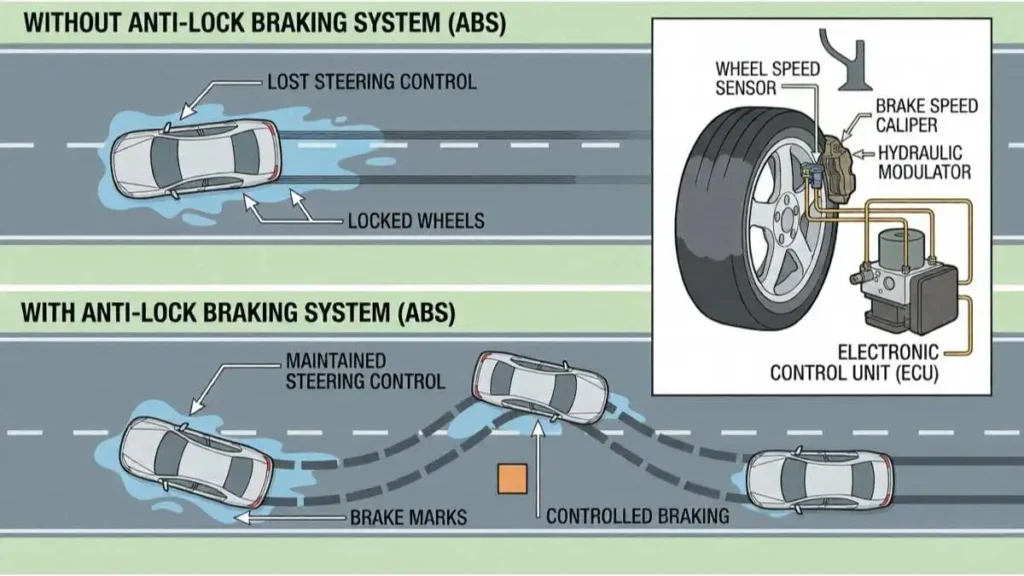
Why Brake Fluid Condition Matters More Than You Think
ABS Testauslösung often reveals a hidden culprit: degraded brake fluid.
Key Insight
ABS systems rely on precise hydraulic response times. Old brake fluid:
- Absorbs moisture (up to 3–4% over time)
- Reduces boiling point
- Causes internal corrosion
Impact on ABS Testing
- Slower valve response
- Increased compressibility
- Erratic pressure control
This is why many manufacturers recommend fluid replacement every 2 years—not just for braking, but for ABS reliability.
ABS Testauslösung and Modern Safety Systems
ABS is no longer isolated. It feeds into:
- Electronic Stability Control (ESC)
- Traction Control
- Autonomous Emergency Braking (AEB)
Critical Insight
If ABS activation fails during testing:
- ESC becomes unreliable
- Vehicle stability is compromised
- ADAS features may disengage
Advanced Diagnostic Insight: Timing Is Everything
One of the most overlooked aspects of ABS Testauslösung is timing analysis.
What Experts Look For
- Valve response delay (milliseconds)
- Pump activation lag
- Sensor signal latency
Even a 10–20 ms delay can indicate:
- Electrical resistance issues
- Mechanical friction
- Control module degradation
When Should You Perform ABS Testauslösung?
You don’t need to test ABS on every vehicle, but certain conditions demand it:
- ABS warning light (even intermittent)
- Uneven braking behavior
- After replacing:
- Wheel speed sensors
- ABS module
- Brake lines or fluid
Final Thoughts: Why ABS Testauslösung Is Non-Negotiable
ABS Testauslösung is not just a diagnostic trick; it’s a functional proof of safety.
A vehicle can pass all static checks and still fail when it matters most: under dynamic braking conditions.
This testing method answers a deeper question:
Not just “Is the system intact?” but “Can it perform under stress?”
That distinction is what separates basic maintenance from expert-level diagnostics.
If you’re serious about brake system integrity, ABS Testauslösung isn’t optional; it’s essential.
FAQs
1. What does ABS Testauslösung actually detect?
It detects dynamic failures in valves, pumps, sensors, and hydraulic circuits that aren’t revealed by static diagnostics.
2. What is a normal ABS valve response time?
Typically, 5–15 milliseconds. Anything above 40 ms suggests a fault.
3. Can a vehicle have ABS issues without warning lights?
Yes. Many mechanical and hydraulic faults do not trigger DTCs.
4. Why combine an oscilloscope with ABS activation?
Because some sensor faults only appear under high-frequency load conditions.
5. Is ABS Testauslösung required after brake fluid replacement?
Yes, in many systems, to cycle valves and remove trapped air.


Lizard Pose: A Complete Guide to Form & Flexibility

Tech Etruesports: The Evolution of Competitive Gaming

Ceıvır: Traditional Turkish Dish with Rich Flavors

GNHUSTGames: The Ultimate Platform for Unblocked Games

Kraams: The Heart of Dutch Market Culture

Butterfly Position: How to Do Baddha Konasana Safely

Tissariss Textile Art: A Tradition of Cultural Weaving

Anna Archive: Free Shadow Library Search Engine

Bl_Faceless: Anonymous Digital Creators Redefining the Digital Space

Pepe Coin Overview: Inside the Meme Cryptocurrency Craze

Lotus Position (Padmasana): How to Do It Safely and Avoid Knee Pain

How to Prepare for a Gynaecology Appointment

RPDJAFUD: The Future of AI-Driven Cybersecurity and Automation

News JotechGeeks: Leading Source for Tech Updates

How to Meditate Daily Without Trying to “Empty Your Mind”
-
 GENERAL1 year ago
Christofle – For Those Who Dream of Family Heirloom Silver
-
SPORTS1 month ago
Discover the World of Football with Streameast: Watch Your Favorite Leagues and Tournaments
-
HOME IMPROVEMENT1 year ago
Spacious and Stylish 300cm Round Rugs: Elegant and Modern Designs for a Chic Home Decor
-
GENERAL8 months ago
Uncovering the World of кинокрадко: The Dark Side of Film Piracy