
EXERCISE
Hip Exercises: A Science-Based System for Strong, Functional Hips

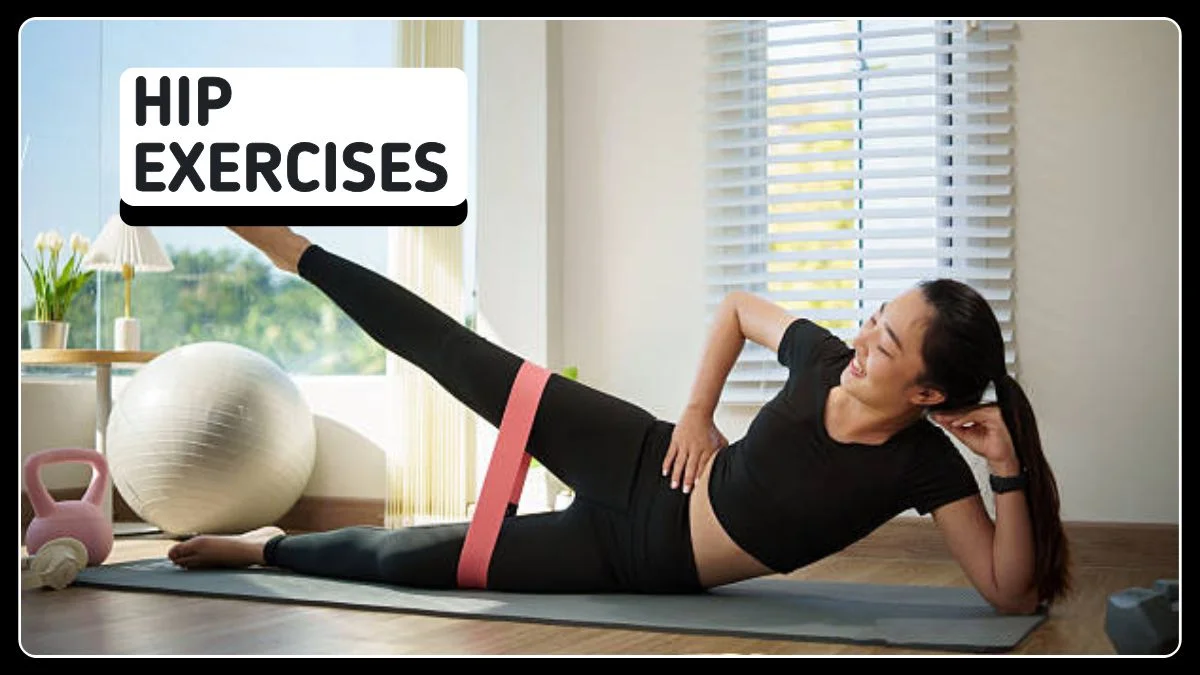
Hip training is often oversimplified into “glute workouts” or generic mobility routines. That approach misses the real issue: the hip is not just a muscle group; it is a load-bearing, force-transferring mechanical hub that directly influences knee tracking, spinal stability, gait efficiency, and athletic power output.
Biomechanics research consistently shows that hip dysfunction, particularly weakness in the hip abductors and external rotators, alters lower-limb loading patterns and increases compensatory stress on the knees and lumbar spine. In gait analysis studies, reduced gluteus medius activation correlates with increased dynamic knee valgus during single-leg stance and landing tasks, a known risk factor for overuse injuries.
Table of Contents
Understanding Hip Function Through a Mechanical Lens
The hip is a ball-and-socket joint designed for both stability and power transmission. Unlike the shoulder, which prioritizes mobility, the hip must manage high ground-reaction forces, often 2.5–5x body weight during running and jumping.
Primary force systems at the hip:
- Sagittal plane: hip flexion/extension (walking, sprinting)
- Frontal plane: pelvic stabilization (single-leg stance)
- Transverse plane: rotational control (cutting, twisting sports)
Most injuries occur when one of these systems is underperforming.
Key Hip Muscles (And What Actually Fails First)
Gluteus Maximus (Power Output Engine)
- Primary hip extensor
- Peak activation occurs in hip extension past neutral
- Underuse leads to hamstring dominance and lumbar compensation
Clinical insight:
EMG studies consistently show the glute max is under-recruited in individuals with prolonged sitting exposure due to neural inhibition patterns (“gluteal amnesia” is an oversimplified but partially valid concept of this phenomenon).
Gluteus Medius (Pelvic Stabilizer)
- Controls femoral internal rotation and pelvic drop
- Critical in single-leg stance (~40% of gait cycle)
Key dysfunction marker:
Contralateral pelvic drop during walking or single-leg squat indicates reduced activation.
Deep External Rotators
- Provide joint centration
- Prevent femoral collapse inward
- Essential for knee alignment control
Hip Flexors (Iliopsoas Complex)
- Often adaptively shortened in sedentary individuals
- Can anteriorly tilt pelvis and inhibit glute activation
Clinical Hip Assessment (What Experts Test First)
Before prescribing hip exercises, clinicians often assess movement quality.
Test 1: Single-Leg Squat Analysis
Look for:
- Knee valgus (inward collapse)
- Pelvic drop
- Foot pronation collapse
Test 2: Trendelenburg Sign
- Drop of opposite pelvis during single-leg stance
- Indicates gluteus medius weakness
Test 3: Hip Internal Rotation Range
- <30° internal rotation often correlates with compensatory lumbar motion patterns
These assessments determine whether you need Strength, mobility, or motor control, not just “more exercise.”
Evidence-Based Hip Exercises (With Mechanistic Rationale)
1. Barbell Hip Thrust (Primary Glute Max Builder)
Why it works:
Hip thrusts maximize gluteus maximus torque in a shortened-to-mid range position where hip extension force production peaks.
Programming:
- 3–5 sets of 6–10 reps
- 2–3 sec eccentric phase
- Full lockouts pause (1 sec)
Common error:
Lumbar hyperextension reduces gluteal activation and shifts the load to the spinal erectors.
2. Romanian Deadlift (Posterior Chain Length Tension Builder)
Mechanism:
Develops hip hinge control under eccentric hamstring tension while reinforcing posterior chain synchronization.
Key cue:
“Hips move backward like closing a car door with your glutes.”
3. Side-Lying Hip Abduction (Gluteus Medius Isolation)
Why it matters:
Low-load, high-specificity activation of lateral hip stabilizers.
Evidence insight:
EMG analysis shows high glute med activation when the hip is slightly extended (not flexed forward).
4. Single-Leg RDL (Integrated Stability + Strength)
Why it is superior:
Combines:
- balance control
- hip hinge mechanics
- anti-rotation stability
This mirrors real gait mechanics more closely than bilateral exercises.
5. 90/90 Hip Rotation Drill (Capsular Mobility Reset)
Purpose:
Restores internal/external rotation balance between femur and acetabulum.
Clinical relevance:
Limited hip IR often forces the lumbar spine to compensate during squatting and cutting movements.
6. Lateral Band Walk (Frontal Plane Stabilization)
Mechanism:
Increases time-under-tension in glute med during dynamic abduction resistance.
Athletic relevance:
Reduces knee valgus collapse during cutting and landing mechanics.
Programming Hip Training (Expert Framework)
Phase 1: Activation (2–3 weeks)
Goal: restore neural connection
- Glute bridges
- Band abductions
- Low-load isometrics
Phase 2: Strength (4–8 weeks)
Goal: force production
- Hip thrusts
- Romanian deadlifts
- Step-ups
Phase 3: Integration (ongoing)
Goal: movement transfer
- Single-leg RDL
- Lunges
- Sport-specific patterns
Hip Pain vs Weakness vs Mobility Restriction
Not all hip “tightness” is the same.
Scenario A: Weak Glutes
- Fatigue in lower back during walking
- Knee instability
- Poor sprint acceleration
Scenario B: Mobility Restriction
- Limited squat depth
- Pinching sensation in hip flexion
- Compensatory lumbar rounding
Scenario C: Motor Control Issue
- Strength exists but is not properly recruited
- Asymmetrical movement patterns
Treatment differs completely depending on classification.
Can Hip Exercises Reduce Knee and Back Pain?
Yes, but indirectly.
Knee pain mechanism:
Weak hip abductors → femur internal rotation → increased patellofemoral stress
Lower back mechanism:
Limited hip extension → lumbar spine compensates during gait and lifting
Multiple clinical rehabilitation protocols for patellofemoral pain syndrome and non-specific low back pain now include hip strengthening as a primary intervention component.
How Long Until Results Appear?
Adaptation timelines (general averages):
- Neural activation improvements: 1–2 weeks
- Strength gains: 4–6 weeks
- Movement pattern changes: 6–12 weeks
- Structural adaptations: 12+ weeks
Consistency matters more than exercise variety.
Common Expert-Level Mistakes
Mistake 1: Only training glutes in sagittal plane
Real movement requires multi-planar control.
Mistake 2: Ignoring hip rotation control
Rotation deficits often cause “invisible” movement dysfunction.
Mistake 3: Overloading before motor control is established
Leads to compensation patterns rather than true strength gains.
FAQs
1. What is the most important hip exercise?
Hip thrusts are highly effective for force production, but single-leg stability exercises are equally important for real-world movement control.
2. How often should hip exercises be done?
2–4 times per week depending on training load and recovery capacity.
3. Do hip exercises fix posture?
They improve pelvic control, which can positively influence posture, but posture is ultimately a dynamic system rather than a fixed position.
4. Can tight hips be weak hips?
Yes. Tightness often reflects neural protection or weakness rather than true muscular shortness.
Conclusion
Hip training is not a cosmetic or accessory component of fitness; it is a structural requirement for efficient human movement. When the hips lose Strength, stability, or mobility, the body does not stop moving; it simply redistributes load to the knees, spine, and surrounding joints.
Effective hip exercises are not defined by popularity but by their ability to restore mechanical efficiency across all three movement planes. When programmed correctly, they improve not only Strength but also movement quality, injury resilience, and long-term joint health.
The real goal is not stronger hips in isolation, but a body that moves as an integrated, efficient system.


Hip Exercises: A Science-Based System for Strong, Functional Hips

Getting Medical Supplies: 5 Tips on Choosing the Right Store

Nexus AlienSync: The Backbone of Interconnected AI Ecosystem

Influencersginewuld: The AI-Powered Future of Influencer Marketing

Common CNC Machining Defects & their Preventive Measures

CurlyMe Hair Half Wig and Headband Wig That Deliver Salon-Worthy Results

Preparing for Foot and Ankle Surgery: What Patients in Singapore May Need to Know

How Digital Manufacturing Is Accelerating Product Development

Window Lock Security: The Forgotten Step in Home Safety

VIPLeague: The Ultimate Sports Paradise for Free Live Streaming

QuArtist: Revolutionizing Quantum AI with Interdisciplinary Innovation

Bunkralbum: Ideal Platform for Relaxation and Cinematic Vibes

Zvideo | The Ultimate Video Streaming Platform for All Genres

How to Meditate Effectively: Science-Based Guide

The Friend Recommendation That Led to Pilates for Seniors
-
 GENERAL12 months ago
Christofle – For Those Who Dream of Family Heirloom Silver
-
SPORTS1 year ago
Discover the World of Football with Streameast: Watch Your Favorite Leagues and Tournaments
-
GENERAL6 months ago
Uncovering the World of кинокрадко: The Dark Side of Film Piracy
-
GENERAL2 months ago
Unveiling the Art of преводсч: How Translators Bridge Language Barriers