YOGA
Legs Behind Head: The Hidden Biomechanics Behind Eka Pada Sirsasana & Yoganidrasana

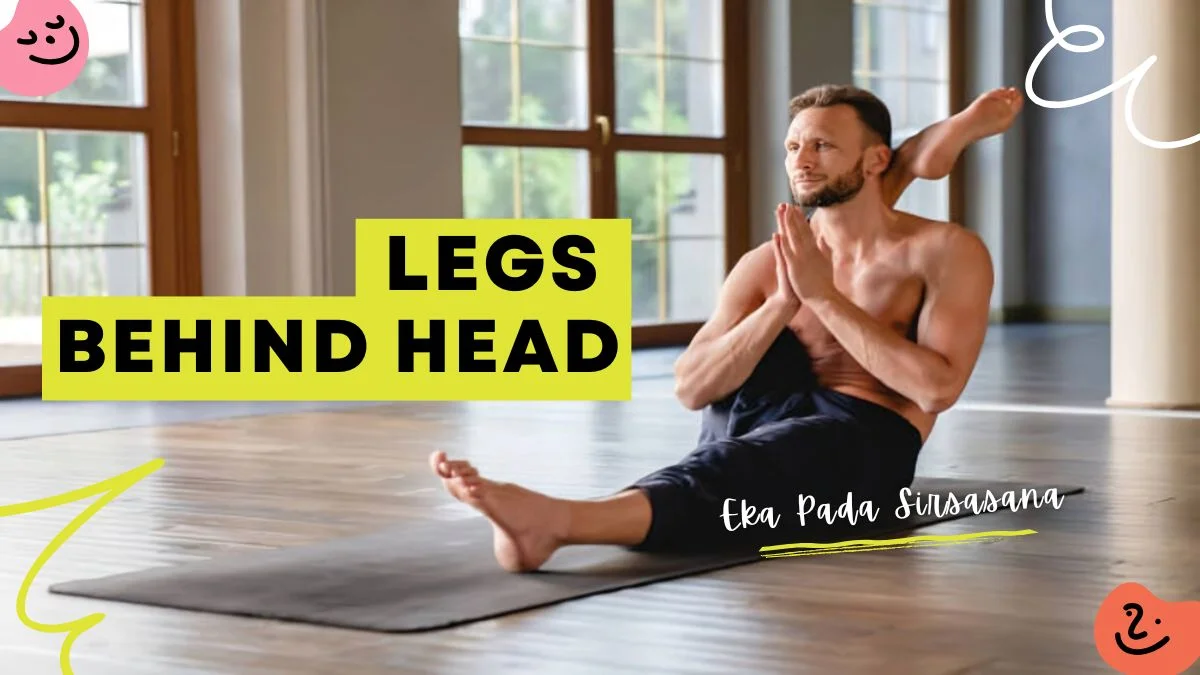
Most people assume that placing the legs behind the head is a “flexibility milestone.” That assumption is incomplete and, in many cases, misleading.
The ability to perform legs behind head, Eka Pada Sirsasana, and Yoganidrasana is not simply a measure of how flexible someone is. It is a complex interaction between hip joint morphology, neural tolerance, motor control, and structural constraints that no amount of stretching can fully override.
Some practitioners will reach these positions safely. Others will train for years and never get close, not for lack of effort, but because of anatomical ceilings that are rarely discussed in mainstream yoga education.
Understanding this distinction changes everything about how you train.
Table of Contents
What “Legs Behind Head” Actually Requires (Beyond Flexibility)
At first glance, these poses appear to demonstrate extreme hamstring flexibility. Biomechanically, that is not accurate.
To place a leg behind the head, the body must coordinate:
- Hip flexion beyond 120–140°
- Extreme hip external rotation
- Controlled hip abduction
- Pelvic posterior tilt without lumbar collapse
- Scapular elevation and cervical neutrality
- Neural tolerance to end-range compression
This is not a single joint action. It is a multi-joint coordination problem.
The limiting factor is rarely the hamstrings. In most practitioners, the restriction originates at the hip capsule or neural structures, not muscle length alone.
Hip Anatomy: The Real Determinant of Eka Pada Sirsasana
The hip joint is a ball-and-socket structure, but not all sockets are identical.
Key anatomical variables:
1. Acetabular depth
A deeper socket provides stability but limits extreme flexion and rotation.
2. Femoral version (angle of femur)
- Increased anteversion → more external rotation potential
- Retroversion → earlier bony block in flexion
3. Femoral neck shape
Subtle variations can create early contact during deep hip flexion.
These factors explain why:
- Some individuals enter Eka Pada Sirsasana within 1–2 years of training
- Others never pass the half-leg-cradle stage despite equal effort
This is not flexibility inequality. It is structural variability.
The Most Ignored Limitation: Neural Tension
When practitioners feel a “deep stretch” behind the leg, they often assume it is muscle length.
In many cases, it is neural tension, primarily involving:
- Sciatic nerve
- Tibial nerve branches
- Posterior femoral cutaneous nerve
Neural tension feels different from muscle stretching:
- Sharp or electric sensations
- Tingling or burning
- Sudden resistance rather than gradual stretch
Muscles adapt well to long-duration loading.
Nerves do not respond the same way.
If neural mobility is ignored, practitioners often hit a plateau where stretching harder produces no progress or symptoms worsen.
This is one of the main reasons legs behind head attempts lead to discomfort in intermediate practitioners.
Eka Pada Sirsasana vs Yoganidrasana: A True Mechanical Comparison
| Biomechanical Factor | Eka Pada Sirsasana (One Leg Behind Head) | Yoganidrasana (Yogic Sleep Pose) |
| Hip Flexion Demand | High unilateral hip flexion (one leg at a time) with controlled lift behind the head | Bilateral extreme hip flexion with both legs simultaneously folding behind the head |
| Hip Rotation Requirement | Strong external rotation on one side, often limited by asymmetry between hips | Deep bilateral rotation with compounded restriction due to both hips working together |
| Spinal Positioning | Mostly upright spinal control with asymmetrical loading and stabilization | Significant spinal flexion and compression, especially thoracic and lumbar regions |
| Primary Challenge Type | Motor control + unilateral mobility integration (coordination-based flexibility) | Global compression tolerance (end-range folding of entire posterior chain) |
| Breathing & Pressure Adaptation | Relatively normal breathing with mild abdominal compression | Noticeable respiratory restriction due to chest and abdomen compression |
Why Knee Pain Happens (And Why It’s Rarely the Knee)
A major misconception in flexibility training is that knee discomfort means a knee problem.
In legs-behind-head attempts, the knee is usually the victim, not the cause.
Mechanism of injury transfer:
- Hip lacks external rotation
- Force continues through the kinetic chain
- Rotation is redirected to the knee joint
- Meniscus and ligaments absorb stress
The knee is a hinge joint. It is not designed to manage torsion.
So when someone forces progression, the knee becomes the site of compensation.
If knee pain appears during these poses, the correct intervention is almost always:
Improve hip mobility and reduce positional load, not push further.
Femoroacetabular Impingement (FAI): The Silent Limiter
Some practitioners experience a “block” in deep hip flexion that does not improve with stretching.
This may be due to Femoroacetabular Impingement (FAI).
Two major types:
Cam-type
Irregular femoral head shape limits clearance in flexion.
Pincer-type
Excess acetabular coverage restricts motion early.
Symptoms often include:
- Deep groin pinching
- Loss of hip depth in flexion
- Sharp end-range block
- Post-training soreness in hip joint
Important insight:
In FAI, additional stretching can worsen symptoms because the limitation is structural rather than muscular.
This is one of the most under-discussed realities in yoga mobility culture.
Passive vs Active Flexibility: The Missing Performance Layer
Most people evaluate flexibility visually.
But advanced practitioners distinguish between two types:
Passive flexibility
Range achieved with external help (gravity, hands, assistance)
Active flexibility
Range controlled by the practitioner independently
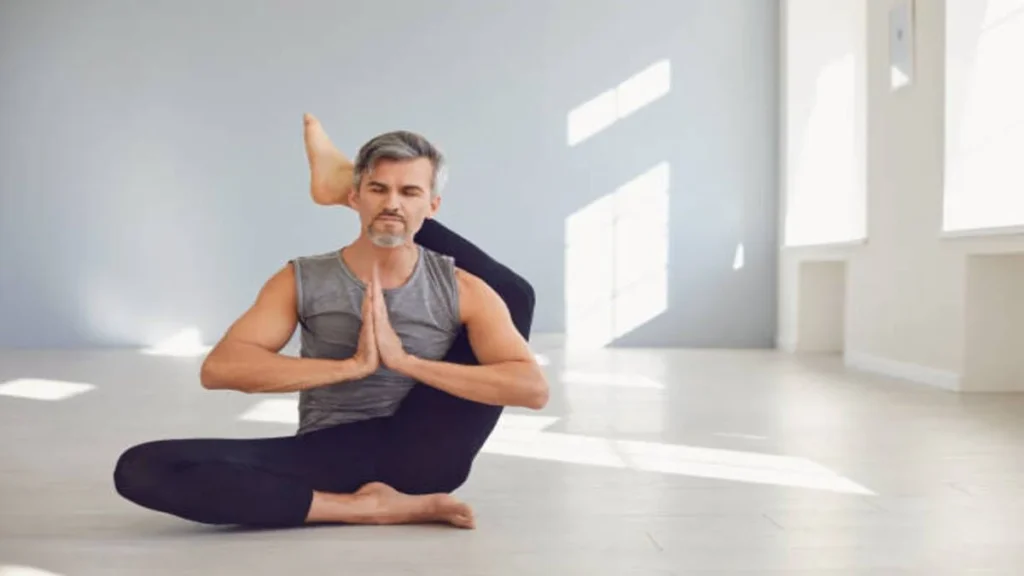
A person may be able to passively place the leg behind the head yet fail to lift it there actively.
This indicates incomplete neuromuscular integration.
Why active flexibility matters:
- Reduces joint instability
- Improve motor control
- Prevents dependency on external force
- Enhances long-term joint health
Without active control, advanced poses are unstable even if they are physically achievable.
Biomechanics of Eka Pada Sirsasana
This pose is often misunderstood as a “leg movement.”
It is a full-body coordination task.
Required joint actions:
Hip:
- Flexion >120°
- External rotation ~80–100°
- Abduction ~45–60°
Spine:
- Controlled flexion without collapse
- Thoracic extension compensation
Pelvis:
- Posterior tilt without sacral strain
Shoulder girdle:
- Stabilization to maintain balance
The leg does not simply “go behind the head.”
It navigates a constrained anatomical tunnel formed by the rib cage, pelvis, and cervical alignment.
Contortion vs Yoga: Two Completely Different Adaptation Systems
Although visually similar, contortion and yoga develop flexibility differently.
Yoga approach:
- Breath-led mobility
- Slow adaptation
- Stability and awareness emphasis
- Joint safety prioritization
Contortion approach:
- End-range strength training
- Progressive overload at extreme ranges
- Frequent exposure to maximal positions
- Performance-driven adaptation
Key difference:
Contortionists do not just stretch more; they strengthen at the end range of motion.
This distinction explains why contortionists often achieve deeper positions with apparent ease.
12-Month Realistic Adaptation Pathway
Progress in legs-behind-head training is slow because connective tissues adapt gradually.
Phase 1 (0–3 months)
- Hip rotation assessment
- Neural mobility screening
- Basic 90/90 drills
Phase 2 (3–6 months)
- Active hip control development
- Compression tolerance work
- Controlled leg cradle positions
Phase 3 (6–9 months)
- Deep hip flexion integration
- Assisted leg-behind-head entry drills
- Stability training
Phase 4 (9–12+ months)
- Independent Eka Pada Sirsasana attempts
- Refinement of balance and breath
- End-range strength building
For many practitioners, this timeline extends beyond a year, or plateaus depending on anatomy.
The Real Question Behind the Pose
Most training fails because the question is wrong.
Instead of asking:
“How do I force my legs behind my head?”
A more advanced question is:
“What specific system, hip joint, neural tissue, or motor control is limiting my range?”
That shift moves the practice from imitation to analysis.
And ironically, that is what separates casual flexibility training from advanced movement science.
Conclusion
The ability to perform Eka Pada Sirsasana or Yoganidrasana is not a universal benchmark of human capability. It is a specialized outcome of anatomy, neural tolerance, and long-term adaptation strategy.
Some bodies are structurally optimized for deep hip rotation. Others are built for stability and load-bearing efficiency. Both are valid expressions of human movement.
The most advanced practitioners are not those who force their bodies into extreme shapes, but those who understand why those shapes are possible in the first place.
In that sense, the real mastery is not putting the legs behind the head.


Lizard Pose: A Complete Guide to Form & Flexibility

Tech Etruesports: The Evolution of Competitive Gaming

Ceıvır: Traditional Turkish Dish with Rich Flavors

GNHUSTGames: The Ultimate Platform for Unblocked Games

Kraams: The Heart of Dutch Market Culture

Butterfly Position: How to Do Baddha Konasana Safely

Tissariss Textile Art: A Tradition of Cultural Weaving

Anna Archive: Free Shadow Library Search Engine

Bl_Faceless: Anonymous Digital Creators Redefining the Digital Space

Pepe Coin Overview: Inside the Meme Cryptocurrency Craze

Lotus Position (Padmasana): How to Do It Safely and Avoid Knee Pain

How to Prepare for a Gynaecology Appointment

RPDJAFUD: The Future of AI-Driven Cybersecurity and Automation

News JotechGeeks: Leading Source for Tech Updates

How to Meditate Daily Without Trying to “Empty Your Mind”
-
 GENERAL1 year ago
Christofle – For Those Who Dream of Family Heirloom Silver
-
SPORTS1 month ago
Discover the World of Football with Streameast: Watch Your Favorite Leagues and Tournaments
-
HOME IMPROVEMENT1 year ago
Spacious and Stylish 300cm Round Rugs: Elegant and Modern Designs for a Chic Home Decor
-
GENERAL8 months ago
Uncovering the World of кинокрадко: The Dark Side of Film Piracy