
GENERAL
What Is ZabaSearch? Data, Privacy & Risks Explained

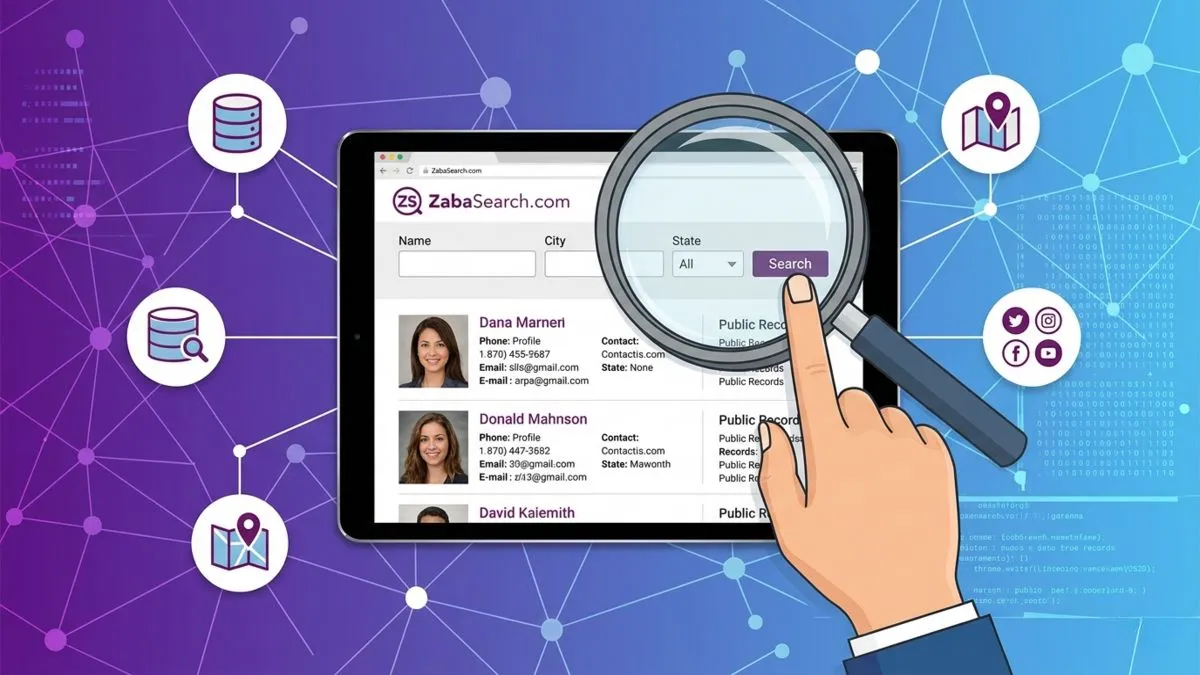
ZabaSearch is a U.S.-focused online people-search platform that aggregates publicly available and commercially sourced personal information into searchable profiles.
Users can search using:
- full names,
- phone numbers,
- cities,
- ZIP codes,
- addresses.
Depending on available records, the platform may display:
- current and previous addresses,
- estimated age ranges,
- possible relatives,
- historical phone numbers,
- location associations,
- and related public-record indicators.
Unlike social media platforms, ZabaSearch generally does not require users to create accounts or voluntarily upload personal biographies.
Instead, it reconstructs identity trails from fragmented external records.
That is why many users find their information there, even if they have never heard of the platform before.
Table of Contents
The Hidden Infrastructure Behind ZabaSearch
Most people misunderstand where the data comes from
A common misconception is that sites like ZabaSearch “steal” information.
The reality is more complex.
Most people-search engines function as data aggregators. They collect legally obtainable information from dozens, sometimes hundreds, of separate sources.
Typical sources include:
Government and county records
- Property tax filings
- Home ownership records
- Business registrations
- Court filings
- Voter registrations
Commercial marketing databases
Advertising companies routinely maintain:
- consumer profiles,
- address histories,
- household associations,
- and demographic estimates.
These datasets are frequently bought, sold, merged, and licensed across the data-broker industry.
Telecom and directory records
Older landline directories and telecom-related databases still influence many people-search systems today.
Secondary broker networks
One broker sells to another.
Then another repackages the information.
Eventually, platforms like ZabaSearch index the results into searchable interfaces.
This creates a chain reaction in which outdated information can persist online for years after it is no longer accurate in real life.
Privacy researchers often call this:
“Data persistence through broker replication.”
Why ZabaSearch Sometimes Knows Your Old Address
Address history is one of the easiest datasets to obtain in America
Many users are shocked when ZabaSearch displays:
- apartments they rented years ago,
- college housing,
- or homes they briefly lived in.
Address histories are among the most commercially available identity datasets in the United States.
A single address may appear across:
- utility records,
- credit-header data,
- property tax systems,
- package delivery databases,
- voter rolls,
- magazine subscriptions,
- insurance records,
- and marketing lists.
Even if one source removes the address, dozens of others may still retain it.
This is why deleting information from one website rarely solves the broader issue.
The internet remembers through duplication.
Testing ZabaSearch: What the Results Actually Look Like
To understand how these systems behave, privacy researchers and cybersecurity analysts often test people-search engines using:
- known historical addresses,
- recycled phone numbers,
- or intentionally outdated records.
A common pattern emerges:
| Data Type | Accuracy Trend |
| Current city | Often accurate |
| Historical addresses | Frequently accurate |
| Phone numbers | Mixed reliability |
| Relative associations | Sometimes incorrect |
| Age estimates | Usually, approximate |
| Employment details | Often missing or outdated |
One recurring issue involves recycled phone numbers.
For example:
a number disconnected in 2017 may later belong to someone else, while broker systems continue linking both identities together.
That creates “identity contamination,” where unrelated individuals become algorithmically associated simply because databases failed to update cleanly.
This is one reason cybersecurity experts warn against treating people-search engines as definitive sources of truth.
Why ZabaSearch Can Become a Privacy Risk
The danger is not one dataset; it is a data combination
By itself, a previous address may seem harmless.
But combine:
- an address,
- a phone number,
- a relative’s name,
- and age estimates,
And suddenly, a malicious actor can begin constructing a detailed identity profile.
This process is called:
Open-Source Intelligence (OSINT)
OSINT is widely used by:
- journalists,
- investigators,
- cybersecurity teams,
- law enforcement,
- and fraud analysts.
But criminals use similar methods too.
A scammer can combine ZabaSearch data with:
- breached-password databases,
- social media accounts,
- Google Maps,
- LinkedIn profiles,
- and public genealogy records
to create highly targeted phishing attacks.
This is why modern identity theft rarely starts with stolen credit cards anymore.
It often starts with publicly accessible identity fragments.
Is ZabaSearch Legal?
Yes, but legality and comfort are not the same thing
ZabaSearch largely operates within U.S. laws governing:
- public information access,
- data brokerage,
- and commercial aggregation.
However, legality does not necessarily eliminate ethical concerns.
Most people never consciously agreed to have:
- movement histories,
- address trails,
- and household associations
assembled into searchable online profiles.
That tension sits at the heart of the modern privacy debate.
The platform also avoids positioning itself as:
- a credit bureau,
- employment screening service,
- or official background-check provider.
This distinction matters because regulated consumer reports in the United States are subject to laws such as the Fair Credit Reporting Act (FCRA).
People-search engines usually avoid those classifications through carefully structured disclaimers.
Why ZabaSearch Pages Rank So Well in Google
Structured data gives people-search sites enormous SEO power
One overlooked aspect of platforms like ZabaSearch is their search engine architecture.
These websites naturally generate:
- millions of indexed pages,
- localized search combinations,
- structured identity data,
- and long-tail keyword coverage.
For example:
- “John Smith Dallas TX”
- “Sarah Johnson Miami phone number”
- “Michael Brown’s previous address”
Each query becomes a highly searchable page.
From an SEO perspective, this creates massive topical breadth.
Many people-search websites dominate branded-name searches simply because:
- their pages are highly structured,
- frequently updated,
- and geographically optimized.
This is why professionals sometimes discover data-broker pages ranking above:
- portfolios,
- LinkedIn accounts,
- or business websites.
The Emotional Side of People-Search Databases
The psychological impact is rarely discussed
Most articles focus only on technical privacy concerns.
But there is also a human side.
Victims of:
- stalking,
- domestic abuse,
- harassment,
- or obsessive online behavior
Often, people describe people-search engines as deeply distressing.
Even ordinary users may feel uneasy discovering:
- old homes,
- family relationships,
- and movement history
presented publicly without context.
Privacy experts sometimes call this:
“Ambient exposure”
the feeling that personal identity trails remain permanently visible online.
That emotional dimension explains why data-broker regulation debates continue to intensify across the United States.
Can You Remove Yourself from ZabaSearch?
Yes, but removal is rarely permanent
ZabaSearch provides opt-out or suppression procedures for certain listings.
Typically, users must:
- Locate their profile
- Submit a removal request
- Verify identity
- Confirm the request by email or another validation step
However, removal from one database does not eliminate:
- upstream data brokers,
- secondary aggregators,
- mirrored databases,
- or future re-indexing.
Privacy professionals often compare this process to:
“Pulling weeds without removing roots.”
The underlying broker ecosystem remains active.
FAQs
1. Does ZabaSearch show criminal records?
It may reference public record indicators, but it is not a comprehensive criminal background system.
2. Why is my information on ZabaSearch if I never signed up?
Most information comes from public records and commercial data brokers rather than direct user registration.
3. Can someone track where I live using ZabaSearch?
Potentially, especially if the current address information appears accurate. That is why many users choose opt-out requests.
4. Is ZabaSearch dangerous?
The platform itself is not inherently malicious, but aggregated personal data can become risky when abused by scammers, stalkers, or identity thieves.
5. What is the difference between ZabaSearch and Whitepages?
Both aggregate public identity information, but their databases, update frequencies, partnerships, and report depths may differ.
ZabaSearch reflects a much larger internet reality
The internet did not create a public record system.
What changed is discoverability.
Before search engines and data brokers, finding someone’s historical records required:
- courthouse visits,
- paper archives,
- phone books,
- and manual investigation.
Now, algorithms perform those connections instantly.
That transformation fundamentally changed the meaning of “public information.”
ZabaSearch is not merely a website. It is evidence of how modern identity systems function:
- fragmented data becomes centralized,
- centralized data becomes searchable,
- searchable data becomes monetized,
- and monetized identity trails become permanent digital shadows.
Most people do not realize this ecosystem exists until they search their own name and see their past staring back at them.


Why Hospital-Employed Physician Practices Keep Losing Money

Wearable Air Purifiers: A Closer Look at the Personal Clean-Air Trend

Preparing for Your Child’s First Dental Visit: A Practical Guide for Parents

What to Look for in a Pilates Studio or Instructor

Why Recurrent Cleaning Services Keep Homes Spotless All Year

AI PPT Maker for Teachers: Turn Lesson Notes into Slides That Leave Room to Teach

Chief Technical Examiner: Roles, Rules and Responsibilities

When Should You Visit an Orthopaedic Clinic for a Sports Injury?

How to Choose an E-Bike for a More Active Everyday Lifestyle

What is Chin Mudra? Discover Its Meaning and Health Benefits

Classroom20x: Future of Hybrid Learning Explained

Exploring the World of Futbolear: A Comprehensive Guide

LeahRoseVIP: Trusted Lifestyle Magazine for Holistic Wellbeing

Daily Spine Care: Simple Habits for Less Strain and More Comfortable Movement

Switching 2nd: Understanding the Shift into Second Gear
-
 GENERAL1 year ago
Christofle – For Those Who Dream of Family Heirloom Silver
-
GENERAL10 months ago
Uncovering the World of кинокрадко: The Dark Side of Film Piracy
-
SPORTS3 months ago
Discover the World of Football with Streameast: Watch Your Favorite Leagues and Tournaments
-
HOME IMPROVEMENT2 years ago
Spacious and Stylish 300cm Round Rugs: Elegant and Modern Designs for a Chic Home Decor