Tech
Quad Equalizer: How 4-Band EQ Actually Works

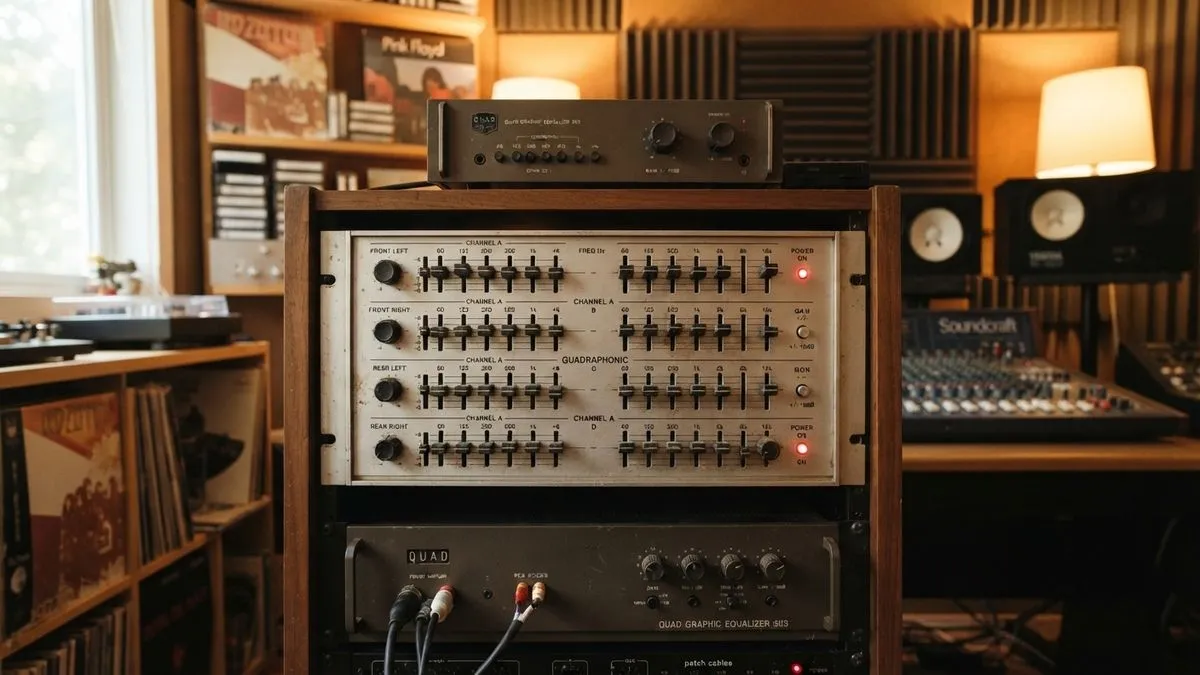
A quad equalizer is a four-band equalization system that lets you alter separate portions of an audio signal. In a typical four-band parametric design, the controls divide into low, low-mid, high-mid, and high sections, with frequency, gain, and sometimes Q available for individual bands. Shure documents this four-band architecture, while Yamaha describes parametric EQ as using frequency, gain, and Q as its fundamental controls.
The useful question is not “What should the four knobs be set to?” There is no universal setting. The better question is which part of the signal is causing the audible problem, why it is causing it, and whether reducing that energy is more appropriate than adding energy somewhere else.
Table of Contents
What Does a Quad Equalizer Control?
Every EQ adjustment changes the amplitude of a selected frequency region. Gain determines how much that region is boosted or attenuated, frequency determines where the adjustment is centered or anchored, and Q determines how narrowly or broadly the filter acts when the design provides adjustable Q. Yamaha notes that increasing Q narrows the affected frequency range. At the same time, lower Q produces a wider adjustment.
That distinction explains why two settings with the same gain can sound completely different. A narrow cut can remove a specific resonance while leaving neighboring frequencies relatively intact; a broad cut changes the overall character of an instrument or mix. The number displayed on the gain control therefore tells you only how much, not how much of the spectrum you are changing.
Understanding the Four Bands
| Band | What it commonly influences | Better diagnostic question |
| Low | Weight, bass energy, rumble | Is the source lacking bass, or is the bass being masked? |
| Low-mid | Body, warmth, congestion | Is excess energy making several sounds occupy the same space? |
| High-mid | Presence, attack, intelligibility | Does clarity require more energy, or less competing energy? |
| High | Brightness, air, hiss | Is the sound dull, or is the playback system already emphasizing highs? |
Don’t treat these labels as four rigid frequency boxes. The exact behavior depends on the equalizer’s implementation, including whether a band is a shelf or bell filter and which frequencies the manufacturer allows you to select.
Low: Don’t Mistake Weak Bass for Missing Bass
A weak-sounding bass line does not automatically justify a low-frequency boost. If the playback system has limited low-frequency extension, increasing EQ gain may demand more excursion from the speaker without producing proportionally more audible bass.
A better test is to make a small cut and listen to balance changes. If reducing excessive low energy makes vocals and instruments clearer, the original problem may have been masking, not insufficient bass.
Low-Mid: The Congestion Zone
Low-mid energy gives instruments physical body, but several sources can accumulate here. A vocal, guitar, piano and bass-heavy arrangement can each sound acceptable alone yet become congested when combined.
This is why a broad, modest low-mid cut can sometimes create more perceived clarity than boosting the high-mid range. You are reducing competing energy instead of forcing the desired sound louder.
High-Mid: Presence Without Harshness
High-mid frequencies strongly affect intelligibility and perceived attack. Raising them can make a vocal easier to understand, but it can also exaggerate consonants, guitar pick noise, snare attack or the aggressive character of some headphones.
The expert move is to determine what became clearer and what became worse. If clarity improves but listening becomes fatiguing, you may be better off reducing competing low-mid energy than continually boosting presence.
High: Brightness Is Not the Same as Detail
High-frequency boosting can make a dull recording sound more open, but it cannot recreate information that was never recorded. It can also expose hiss, harsh cymbals and amplifier noise.
For that reason, excessive treble is often mistaken for “more detail.” A brighter signal may sound more impressive in a quick comparison, even though it adds more high-frequency emphasis rather than more actual information.
Parametric vs Graphic Quad Equalizer
The term quad equalizer refers to the number of bands, not necessarily the type of EQ.
A four-band graphic EQ normally gives you predetermined frequency regions. A four-band parametric EQ provides more control because the user can typically select frequency and gain and, depending on the design, Q as well. That makes parametric EQ more useful for a specific resonance rather than a broad tonal imbalance.
| Characteristic | Graphic-style 4-band EQ | Parametric 4-band EQ |
| Frequency choice | Limited/fixed | Usually, adjustable |
| Gain | Adjustable | Adjustable |
| Q | Usually fixed | Often adjustable |
| Fast tonal shaping | Excellent | Good |
| Narrow correction | Limited | Stronger |
| Risk of over-adjustment | Lower | Higher if poorly diagnosed |
More control is not automatically better. A four-band parametric EQ can encourage users to chase tiny frequency changes that are inaudible or caused by the room, not the source.
A Better Way to Set a Quad Equalizer
Start with the EQ flat, then isolate the problem before changing multiple bands. The following workflow prevents the common mistake of creating a complicated curve without knowing what each adjustment accomplished.
- Listen to the unprocessed signal. Identify one specific problem.
- Decide whether the problem is excess or deficiency.
- Try a small cut if excessive energy is suspected.
- Change one band at a time.
- Adjust Q according to the problem’s width.
- Bypass the EQ and compare at matched volume.
Volume matching deserves special attention. If the processed signal is louder, it can appear better simply because louder playback often attracts more attention. A valid comparison requires approximately equal perceived level.
How to Choose Q
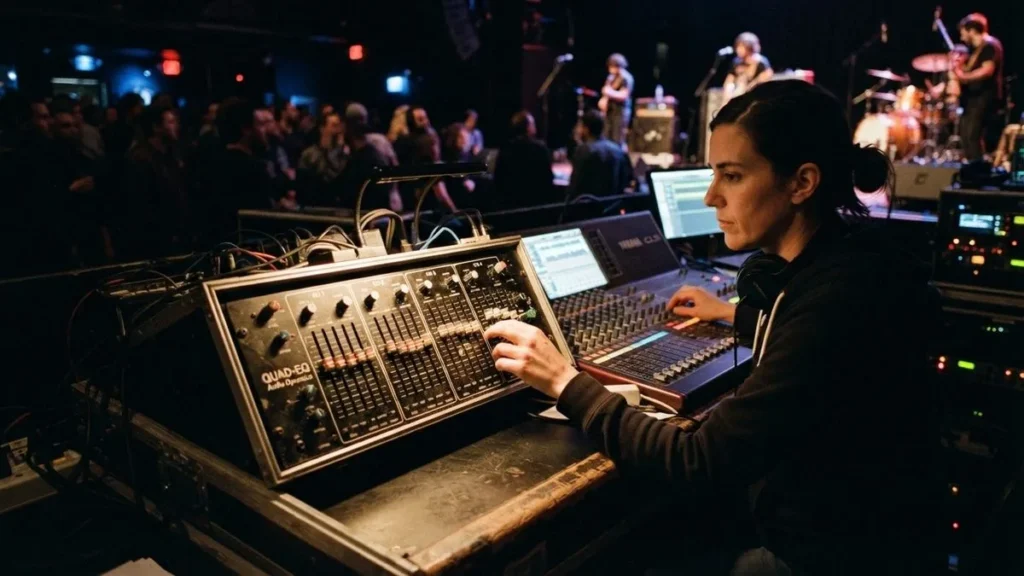
Q should follow the shape of the problem, not a memorized number.
A broad tonal imbalance calls for a broader filter because the unwanted character extends over a larger frequency range. A narrow whistle, resonance or ringing frequency may require a narrower filter so that useful neighboring frequencies remain relatively untouched.
There is a practical warning here: an extremely narrow cut can solve a measurement problem while making little audible improvement, whereas an unnecessarily broad cut can change the character of the entire source. The goal is not the narrowest possible filter; it is the least destructive filter that solves the audible problem.
Cut or boost? Use This Diagnostic Test
Suppose a vocal sound is buried.
Approach A: boost the high-mid band.
This can increase vocal presence, but it also raises guitars, cymbals or other material occupying the same range.
Approach B: reduce competing low-mid energy.
If congestion was masking the vocal, the vocal may become clearer without requiring a large presence boost.
Quad Equalizer Troubleshooting
| Audible symptom | First thing to investigate | Common mistake |
| Muddy mix | Low-mid buildup | Cutting too much bass |
| Thin vocal | Excessive low-mid cut | Boosting bass broadly |
| Buried vocal | Masking vs insufficient presence | Large high-mid boost |
| Harsh headphones | High-mid/high emphasis | Removing all treble |
| Weak bass | Speaker/system limitation | Extreme low-end boost |
| Boomy sound | Low-frequency resonance | Boosting other bands |
| Hissy recording | High-frequency noise | Increasing treble for “detail” |
Mistakes That Make a Quad EQ Less Effective
- Boosting all four bands usually indicates that the EQ is being used as a volume control rather than a corrective tool. If everything needs boosting, check the system gain structure first.
- Copying EQ presets is another weak strategy. A setting that compensates for one headphone model may be inappropriate for another because their frequency responses differ.
- Using EQ to repair a room problem has limits. Room modes can produce peaks and nulls that a handful of broad filters can’t reliably correct, especially when cancellations occur.
- Making changes without bypassing removes the most important reference: the original signal. Every adjustment should survive an A/B comparison, preferably with matched level.
When Four Bands Are Enough and When They Aren’t
Four bands are sufficient for broad tonal shaping and many practical corrective tasks. They become restrictive when a source contains several independent narrow resonances that need separate treatment.
More bands should therefore be viewed as additional problem-solving capacity, not automatically better sound. If two or three carefully chosen filters solve the audible problem, adding six more filters just because the equalizer provides them increases complexity without necessarily improving the result.
One Important Meaning of “Quad Equalizer”
Audio is not the only field that uses this terminology. In high-speed digital electronics, a quad equalizer can mean a device containing four independent equalization channels used to compensate for signal loss in transmission paths.
Texas Instruments’ DS32EV400, for example, is a programmable quad equalizer designed for four high-speed NRZ data channels. It compensates for signal integrity rather than musical tone control.
Therefore, context matters. Terms such as bass, treble, Q, frequency response and parametric EQ point toward audio, while Gbps, data lanes, PCB traces, jitter and NRZ point toward high-speed electronics.








Quad Equalizer: How 4-Band EQ Actually Works

Artificial Zoo: How Technology Creates Digital Wildlife

Hajoca Hub: Streamlining Operations for the Nation’s Top Distributor

Saturn in Aries: Discipline Meets Fiery Ambition

Movierulz: Risks, Legal Consequences, and Industry Impact

The Evolution of AI Image Generation: From Simple Prompts to Photorealistic Art

How to Keep Up Your Yoga Practice While Camping

Mylt34: Streamlining Tasks and Enhancing Productivity

Prizmatem – Next-Gen Digital Prism Technology

Delta Fitness Authority: Gym & Wellness Solutions in KSA

Crocolini: Health Benefits and How to Cook It

5StarsStocks.com: Top Stock Market Platform for Smarter Investing

Kidney Stones and Urinary Problems: Understanding CT Urinary Tract Imaging

NFTRandomize for Cinema4D: Create Unique NFTs with Ease

RemixPapa Study: Revolutionizing Online Learning with Multimedia and AI Tools
-
 GENERAL1 year ago
Christofle – For Those Who Dream of Family Heirloom Silver
-
SPORTS1 month ago
Discover the World of Football with Streameast: Watch Your Favorite Leagues and Tournaments
-
HOME IMPROVEMENT1 year ago
Spacious and Stylish 300cm Round Rugs: Elegant and Modern Designs for a Chic Home Decor
-
GENERAL9 months ago
Uncovering the World of кинокрадко: The Dark Side of Film Piracy