
GENERAL
Navigator Pear: Ornamental Tree Size, Fruit & Care


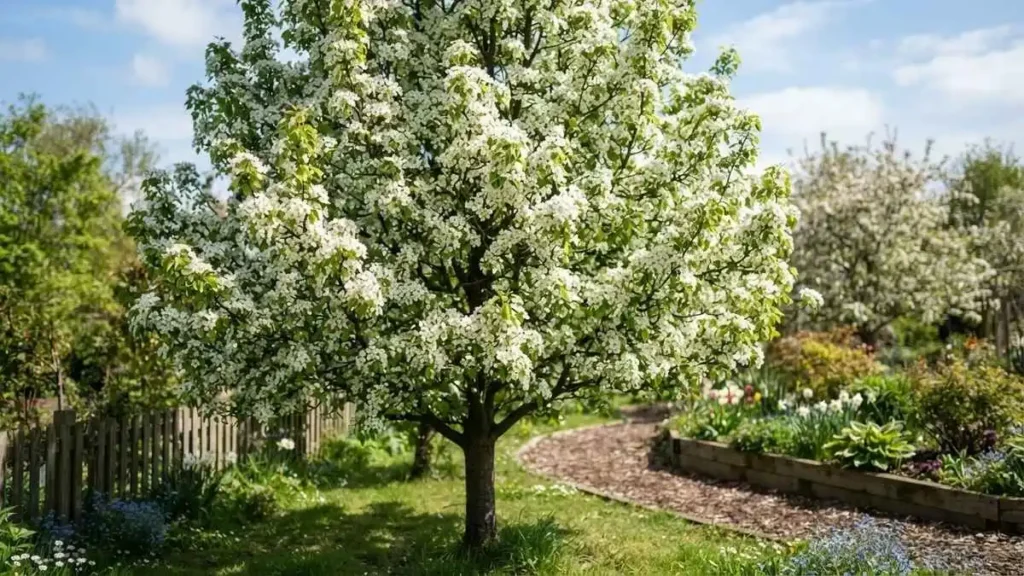
Navigator Pear is an ornamental pear cultivar sold as Pyrus × ‘DurPSN303’. Its appeal is not primarily the production of large edible pears; instead, the cultivar is valued for its upright growth habit, white spring flowers, glossy green foliage, autumn color, and cold hardiness.
Navigator Pear is particularly interesting where a tree needs to grow more upward than outward. Its relatively narrow architecture makes it useful beside streets, driveways, buildings, and other locations where a broad-canopied shade tree would take up too much lateral space.
Navigator Pear at a Glance
| Characteristic | Navigator Pear |
| Botanical name | Pyrus × ‘DurPSN303’ |
| Type | Ornamental pear |
| Growth habit | Upright to pyramidal |
| Flowers | White, spring |
| Foliage | Glossy green |
| Fall color | Yellow to orange |
| Main landscape value | Form, flowers, foliage and seasonal color |
| Light | Full sun |
| Soil | Moist but well-drained |
| Fruit | Small fruit; production can vary |
| Reported mature height | Roughly 23–35 ft, depending on source and conditions |
| Primary purpose | Ornamental landscaping |
Published mature dimensions differ substantially. Some nursery descriptions place the tree around 23–26 feet tall, while others list approximately 35 feet. That variation is important: planting based on the smallest catalog figure can leave you with an undersized clearance plan later.
Table of Contents
Does Navigator Pear Produce Pears?
Yes, Navigator Pear can produce fruit, but the presence of fruit should not be confused with the characteristics of a productive fruit-tree cultivar.
Nursery descriptions report small fruit, with some sources describing approximately 1-inch fruit and others indicating that fruit production can be limited. Pollination conditions can also affect weather and how heavily an ornamental pear sets fruit.
The useful way to think about it is through four separate questions:
- Can it produce fruit? Yes.
- Is fruit production its primary purpose? No.
- Are the fruits comparable to commercial dessert pears? Not as a cultivar-selection objective.
- Should you plant it when dependable edible harvests are the goal? No; a dedicated fruiting pear is more appropriate.
What Does Navigator Pear Fruit Look Like?
The fruit is considerably less important than the tree’s flowers and foliage. Nursery descriptions characterize it as small, rather than the large, elongated fruit associated with familiar supermarket pears.
That difference is useful when planning a landscape. If you want an ornamental tree that occasionally produces small fruit, it can fit that role. If you want enough fruit for eating, preserving, or baking, look for a cultivar specifically selected for fruit size, flavor, harvest season, and yield.
How Big Does Navigator Pear Get?
Expect a medium-sized ornamental tree rather than a dwarf pear.
The published dimensions deserve particular attention because different sources report different mature sizes. Jeffries Nurseries lists approximately 35 feet tall and 18 feet wide, while another nursery source gives approximately 23–26 feet tall and 10–13 feet wide.
This doesn’t necessarily mean one source is wrong. Mature tree dimensions depend on growing conditions, climate, soil, irrigation, establishment, pruning, and how the nursery defines mature size.
For landscape planning, use the larger credible estimate as your safety margin. A tree that eventually becomes 18 feet wide cannot be treated as a 10-foot tree simply because a smaller catalog figure appeared on the plant label.
Why Its Upright Shape Matters
Navigator Pear’s upright habit is more than an aesthetic description. It affects where you can realistically plant the tree.
Imagine two sites with the same total area. A broad shade tree may eventually interfere with a driveway or neighboring planting, while an upright pear can direct more of its canopy vertically.
However, “narrow” does not mean “small.” The tree can still grow quite tall, so the planting decision should consider both canopy spread and overhead clearance.
This is particularly important nearby:
- utility lines
- roofs and gutters
- narrow driveways
- sidewalks
- property boundaries
- street corridors
- buildings with limited setback
Where Should You Plant Navigator Pear?
Full sun is the logical starting point because nursery specifications recommend full-sun exposure. A sunny position also gives the tree better conditions for flowering and maintaining its characteristic foliage.
Soil drainage is equally important. It generally prefers moist, well-drained soil, meaning regular access to moisture without prolonged saturation.
A useful site test is to observe how quickly water disappears after substantial rainfall. If water repeatedly remains around the proposed planting location, simply increasing irrigation later will not solve the underlying drainage problem.
How to Plant Navigator Pear Correctly
The most important planting decision is not fertilizer. It is root placement.
When installing the tree:
- Find the root flare before digging the final hole.
- Make the planting hole wider than the root ball rather than excessively deep.
- Position the root flare at approximately the surrounding soil level or slightly above it.
- Remove obvious circling or severely distorted roots when appropriate.
- Backfill around the roots without creating a buried trunk.
- Water thoroughly after planting.
- Apply much across the root zone but leave the trunk base exposed.
Planting too deeply is especially problematic because the tree may appear healthy initially while the buried trunk flare and upper roots remain in an unfavorable environment.
The goal is not to make the tree look planted “deep and secure.” The goal is to give roots access to oxygen while maintaining enough soil moisture for establishment.
Navigator Pear Watering: The Important Part
Young Navigator Pear trees need consistent moisture while establishing their root system. The mistake is to interpret this as a requirement for constantly wet soil.
A better approach is deep, thorough watering followed by monitoring the soil and weather. Sandy soils may require more frequent irrigation than heavier soils, while poorly drained sites require caution rather than additional water.
Once established, the tree’s irrigation needs depend heavily on climate and rainfall. During prolonged drought, supplemental water can protect growth and foliage, but repeatedly watering saturated soil can create other root problems.
How Should Navigator Pear Be Pruned?
Pruning should primarily establish a sound structure rather than force the tree into an artificial shape.
Look for:
- Competing leaders
- branches with weak attachment
- crossing or rubbing branches
- damaged limbs
- poorly positioned growth
The advantage of correcting these problems early is simple: you can remove a small branch with minimal damage, whereas waiting until it becomes a major limb creates a much larger pruning wound.
Avoid treating an upright ornamental pear like a hedge. Heavy shearing can destroy the natural form that makes the cultivar useful in the first place.
Navigator Pear vs. Fruiting Pear
The distinction becomes clearer when you compare the two.
| Goal | Navigator Pear | Fruiting Pear |
| White spring flowers | Strong landscape feature | Depends on cultivar |
| Upright form | Major advantage | Varies |
| Ornamental foliage | Important feature | Secondary |
| Fall color | Landscape value | Varies |
| Large edible fruit | Not its main purpose | Primary purpose |
| Reliable harvest | Not the main reason to plant it | Major objective |
| Orchard use | Poor fit | Appropriate |
| Narrow landscape position | Potentially useful | Depends on cultivar |
Is Navigator Pear Suitable for a Small Yard?
It can work in a small yard if the available space is narrow but still provides enough vertical and lateral clearance.
Do not judge suitability solely by the width of the trunk or the tree’s nursery-container size. The relevant measurement is the eventual canopy and height.
For a restricted property, map the planting location against the tree’s expected mature dimensions before purchasing. If an overhead utility line sits directly above the planting site, a different tree may be more appropriate, regardless of how narrow Navigator Pear looks at the nursery.
Navigator Pear vs. Callery Pear: Are They the Same?
This distinction deserves attention because “ornamental pear” is sometimes used as though it describes one plant.
Navigator Pear is marketed as Pyrus × ‘DurPSN303’, whereas Callery pear is Pyrus calleryana. Callery pear has documented invasive behavior in parts of North America, where it can escape cultivation and establish in natural areas.
That doesn’t mean it should automatically be labeled invasive just because both belong to the genus Pyrus. At the same time, gardeners should check regional invasive-plant guidance before planting ornamental pears because environmental risks and regulations vary by location.
5 Mistakes to Avoid When Buying Navigator Pear
1. Buying it for fruit.
Its small fruit is secondary to its ornamental characteristics.
2. Planning around the smallest mature-size figure.
Use a conservative size estimate when calculating clearance.
3. Assuming upright means dwarf.
The tree’s narrow architecture does not eliminate its eventual height.
4. Planting into permanently wet soil.
Moisture availability and poor drainage are not the same thing.
5. Ignoring the cultivar identity.
“Ornamental pear” is a broad retail description. Check the actual cultivar name on the plant label so you know what you are buying.







Navigator Pear: Ornamental Tree Size, Fruit & Care

Quad Equalizer: How 4-Band EQ Actually Works

Artificial Zoo: How Technology Creates Digital Wildlife

Hajoca Hub: Streamlining Operations for the Nation’s Top Distributor

Saturn in Aries: Discipline Meets Fiery Ambition

Movierulz: Risks, Legal Consequences, and Industry Impact

The Evolution of AI Image Generation: From Simple Prompts to Photorealistic Art

How to Keep Up Your Yoga Practice While Camping

Mylt34: Streamlining Tasks and Enhancing Productivity

Prizmatem – Next-Gen Digital Prism Technology

Delta Fitness Authority: Gym & Wellness Solutions in KSA

Crocolini: Health Benefits and How to Cook It

5StarsStocks.com: Top Stock Market Platform for Smarter Investing

Kidney Stones and Urinary Problems: Understanding CT Urinary Tract Imaging

NFTRandomize for Cinema4D: Create Unique NFTs with Ease
-
 GENERAL1 year ago
Christofle – For Those Who Dream of Family Heirloom Silver
-
SPORTS2 months ago
Discover the World of Football with Streameast: Watch Your Favorite Leagues and Tournaments
-
HOME IMPROVEMENT1 year ago
Spacious and Stylish 300cm Round Rugs: Elegant and Modern Designs for a Chic Home Decor
-
GENERAL9 months ago
Uncovering the World of кинокрадко: The Dark Side of Film Piracy