
GENERAL
Kalibraatio: The Science of Trusting Measurements

A laboratory reports a blood glucose level slightly off by just 5%. A manufacturing plant produces components with microscopic dimensional errors. A satellite sensor drifts by a fraction of a degree. Individually, these deviations seem minor; collectively, they can lead to misdiagnosis, product recalls, or mission failure.
This is where Kalibraatio, the disciplined process of aligning measurement systems to known standards, quietly becomes one of the most critical pillars of modern science, engineering, and healthcare.
Kalibraatio isn’t just about “checking accuracy.” It’s about establishing trust in data and without that trust, every downstream decision becomes questionable.
Table of Contents
What Is Kalibraatio?
At its core, Kalibraatio is the process of comparing a measuring instrument against a traceable reference standard and adjusting it (if necessary) to ensure its readings fall within acceptable limits.
But the nuance matters:
- It’s not always about adjusting; sometimes it’s just verifying.
- It’s not about perfection; it’s about quantified uncertainty.
- It’s not one-time, it’s periodic and context dependent.
Key Components of Kalibraatio
- Reference Standard: A known, highly accurate measurement (traceable to national/international standards).
- Instrument Under Test (IUT): The device being calibrated.
- Measurement Uncertainty: A quantified range within which the true value lies.
- Tolerance Limits: Acceptable deviation thresholds.
Without these, calibration becomes guesswork rather than science.
Why Kalibraatio Is Non-Negotiable
1. Error Accumulation Is Invisible, Until It’s Too Late
All instruments drift over time due to:
- Thermal expansion
- Mechanical wear
- Electronic noise
- Environmental exposure (humidity, radiation, vibration)
Even high-end equipment like spectrometers or MRI systems can drift subtly. Without calibration, errors compound silently.
2. Regulatory Compliance and Legal Accountability
Industries like pharmaceuticals, aerospace, and healthcare operate under strict standards:
- ISO/IEC 17025 (testing and calibration labs)
- FDA regulations (medical devices)
- GMP (Good Manufacturing Practice)
Failure to maintain calibration records can invalidate entire datasets or product batches.
3. Safety-Critical Applications
Consider:
- Radiation dose calibration in CT scanners
- Oxygen sensors in ICU ventilators
- Pressure gauges in chemical plants
A miscalibrated device here doesn’t just affect data; it affects human lives.
Types of Kalibraatio
Primary Calibration
Performed using fundamental physical constants or national standards. Rare and highly specialized.
Secondary Calibration
Uses calibrated reference instruments. Common in industrial and lab environments.
In-House vs. External Calibration
| Type | Advantage | Limitation |
| In-house | Faster, cost-effective | Requires expertise |
| External (accredited labs) | High traceability, compliance | Expensive, time-consuming |
Static vs. Dynamic Calibration
- Static: Measures constant values (e.g., weight scales)
- Dynamic: Measures changing signals (e.g., ECG monitors, oscilloscopes)
Dynamic calibration is significantly more complex due to time-dependent variables.
How Does the Kalibraatio Process Work?
1. Pre-check Inspection
- Physical condition
- Environmental factors
2. Baseline Measurement
- Compare instrument reading with the standard
3. Error Calculation
- Deviation = Measured Value – True Value
4. Adjustment (if applicable)
- Mechanical, electrical, or software correction
5. Re-verification
- Confirm corrected accuracy
6. Documentation
- Calibration certificate
- Uncertainty values
- Traceability chain
Measurement Uncertainty: The Most Misunderstood Concept
Many assume calibration guarantees exact accuracy doesn’t.
Instead, it defines how confident we are in a measurement.
Example
A thermometer reads 37.0°C with ±0.2°C uncertainty:
- True value lies between 36.8°C and 37.2°C
This range matters critically in:
- Clinical diagnosis
- Chemical reactions
- Material testing
Understanding uncertainty transforms calibration from a checkbox task into a statistical discipline.
Real-World Applications of Kalibraatio
1. Medical Imaging and Radiology
In CT and MRI systems:
- Detector calibration ensures accurate signal intensity
- Dose calibration ensures patient safety
Even slight miscalibration can:
- Distort diagnostic images
- Lead to incorrect clinical decisions
2. Industrial Manufacturing
Precision tools like:
- CNC machines
- Coordinate Measuring Machines (CMM)
require micron-level accuracy. Calibration ensures:
- Consistency across batches
- Reduced waste and rework
3. Environmental Monitoring
Sensors measuring:
- Air quality (PM2.5, CO₂)
- Water contamination
must be calibrated to detect subtle changes. Poor calibration leads to false safety assumptions.
4. Research Laboratories
Instruments like:
- Spectrophotometers
- Chromatographs
Depending on calibration for reproducibility; without it, experimental results cannot be validated.
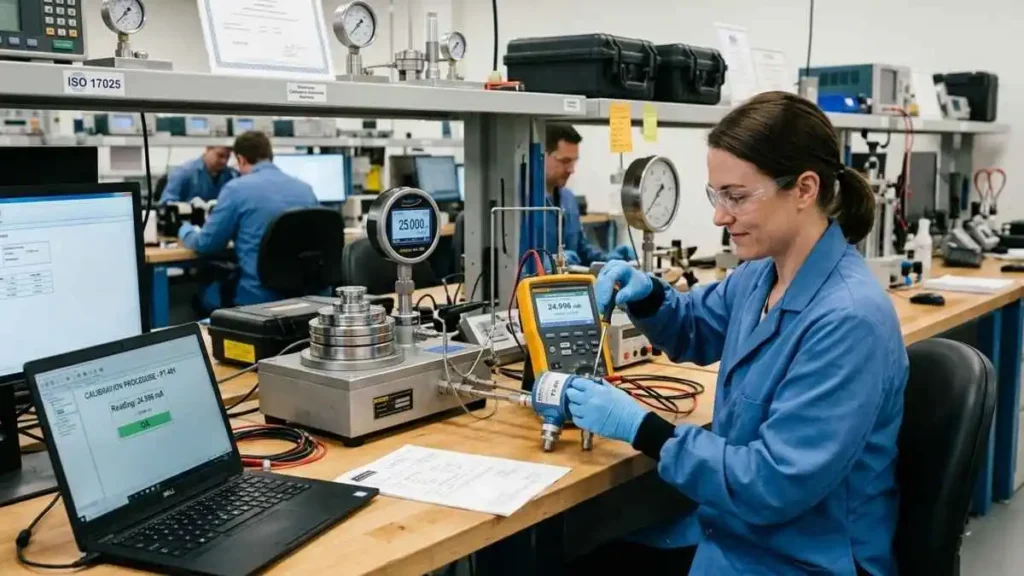
How Often Should Instruments Be Calibrated?
There is no universal answer, but there is a strategy.
Calibration Frequency Depends On:
- Usage intensity (daily vs. occasional)
- Environmental exposure
- Criticality of measurement
- Manufacturer recommendations
- Historical performance data
Smart Approach: Risk-Based Calibration
Instead of fixed intervals:
- Increase frequency for high-risk instruments
- Reduce for stable, low-impact devices
Advanced labs now use predictive calibration models that leverage historical drift data.
Common Calibration Mistakes
1. Ignoring Environmental Conditions
Temperature and humidity directly affect measurements.
2. Using Non-Traceable Standards
If your reference isn’t certified, your calibration is meaningless.
3. Overlooking Measurement Uncertainty
Reporting only “corrected values” without uncertainty is incomplete.
4. Calibration Without Documentation
No certificate = no proof = no compliance.
5. Confusing Calibration with Adjustment
Calibration identifies error; adjustment corrects it. They are not the same.
Is Kalibraatio the Same as Validation or Verification?
Not quite.
| Term | Purpose |
| Calibration | Compare against standard |
| Verification | Confirm it meets specs |
| Validation | Ensure it performs intended function |
In regulated industries, all three are required, but serve different roles.
FAQs
1. What happens if calibration is skipped?
Measurement drift accumulates, leading to inaccurate data, failed audits, safety risks, and financial losses due to rework or recalls.
2. Can software-based instruments be calibrated?
Yes. Even digital systems require calibration because:
Sensors feed them data
Algorithms can introduce systematic bias
3. How is calibration traceable?
Through a chain:
Instrument → Reference Standard → National Standard → International Standard (SI units)
This ensures global consistency.
4. What is a calibration certificate?
A formal document containing:
Measurement results
Uncertainty values
Traceability information
Calibration date and validity
It’s essential for audits and compliance.
Emerging Trends in Kalibraatio
1. Automated Calibration Systems
Robotics and AI now perform calibration with minimal human intervention.
2. Remote Calibration (IoT-Based)
Connected devices can be calibrated remotely using cloud-based standards.
3. Predictive Maintenance Integration
Calibration is being integrated into predictive maintenance systems using machine learning.
4. Digital Calibration Certificates (DCC)
Replacing paper-based documentation with secure, traceable digital formats.
The Hidden Cost of Poor Calibration
Organizations often underestimate the financial impact:
- Product recalls
- Regulatory fines
- Equipment downtime
- Reputation damage
A single miscalibrated sensor on a production line can cost millions, making calibration one of the highest-ROI quality-control processes.
Final Perspective
Kalibraatio is not a routine checkbox; it’s a foundation of credibility in any field that relies on measurement. Whether you’re diagnosing a patient, manufacturing aerospace components, or conducting scientific research, the integrity of your results depends on how well your instruments are calibrated.
The real question isn’t “Do you calibrate your equipment?”
It’s “How much uncertainty are you willing to accept in your decisions?”
And in high-stakes environments, the only acceptable answer is as little as possible.


Acamento: The Artful Science of Finishing with Purpose

Aura Farming: The Viral Slang Shaping Digital Identity

SoSoActive: Lifestyle & Culture for Millennials & Gen Z

Prasarita Padottanasana: How to Do It Correctly

From Webinar Recordings to Social Clips with Video Cutter AI

A Little Room to Breathe: Making Quieter AI Videos with Wan 3.0

Kouskousi: How Traditional Couscous Is Made and Served

When Should You Consider Lower Eyelid Surgery?

What to Look for When Choosing a Memory Care Community

Best IPTV Australia Services in 2026: A Comprehensive Review

Ashtanga Vs Vinyasa Yoga? Which One Should You Choose?

What Is Enhydro? Exploring Water-Filled Fossilized Amber

Unlocking Mamgatoto: The Cultural Phenomenon Shaping Communities Worldwide

DeviceURL in VEX Robotics: Node.js Communication Explained

Navigator Pear: Ornamental Tree Size, Fruit & Care
-
 GENERAL1 year ago
Christofle – For Those Who Dream of Family Heirloom Silver
-
SPORTS2 months ago
Discover the World of Football with Streameast: Watch Your Favorite Leagues and Tournaments
-
HOME IMPROVEMENT2 years ago
Spacious and Stylish 300cm Round Rugs: Elegant and Modern Designs for a Chic Home Decor
-
GENERAL9 months ago
Uncovering the World of кинокрадко: The Dark Side of Film Piracy