
GENERAL
Back Casting Room: Definition, Setup & Best Practices

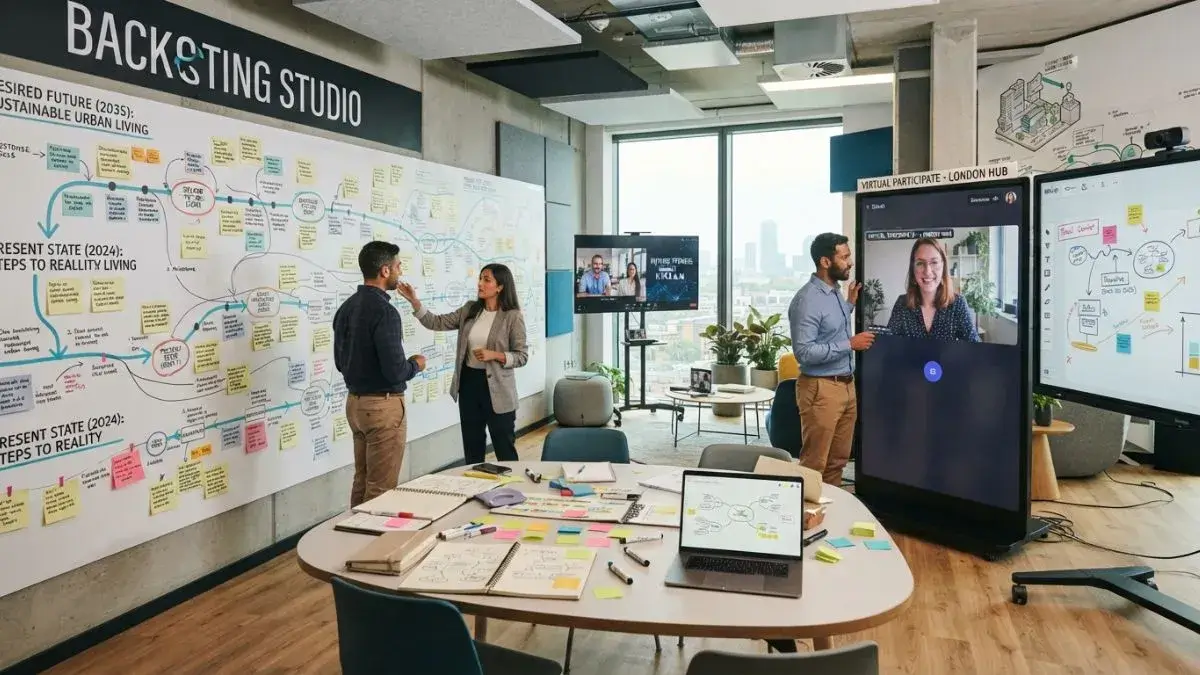
A back casting room is a dedicated physical or virtual workspace where organizations use the backcasting planning method to design long-term strategies. Rather than forecasting future outcomes from today’s conditions, participants first define a clearly articulated future success, typically five to ten years ahead and then work backwards to identify every milestone, capability, policy, investment, and decision required to reach that destination.
Table of Contents
What Is a Backcasting Planning Method?
Backcasting is a strategic planning approach originally developed for solving complex, long-term problems where historical trends offer limited guidance. Unlike forecasting, which asks, “Where are current trends taking us?” backcasting asks, “If success already existed, what sequence of events must have happened?”
The distinction matters because disruptive innovation rarely emerges from extending existing trends. Organizations that rely only on forecasting often optimize today’s systems, while those using backcasting deliberately design tomorrow’s systems.
| Forecasting | Backcasting |
| Starts with today’s conditions | Starts with the desired future |
| Projects trends forward | Works backwards from success |
| Assumes continuity | Encourages transformational thinking |
| Focus on prediction | Focuses on strategic design |
| Best for stable environments | Best for uncertainty and innovation |
What Is a Back Casting Room?
A back casting room is the operational environment where the backcasting methodology is performed. It combines visualization tools, collaborative planning techniques, structured facilitation, and decision frameworks into one workspace.
In a physical setting, the room typically includes:
- Large wall timelines spanning multiple years
- Whiteboards and strategic planning canvases
- Sticky notes categorized by themes
- Digital displays for data and scenarios
- Space for collaborative workshops
- Decision matrices and milestone boards
Virtual back casting rooms replicate these features using collaborative whiteboard software, shared documents, digital roadmaps, and video conferencing platforms.
The objective is not brainstorming alone. Every activity inside the room moves participants closer to answering one practical question:
“If our future success already exists, what had to happen immediately before it?”
How a Back Casting Room Works
Most successful backcasting sessions follow five distinct phases.
1. Define the Future State
Participants begin by describing success in measurable terms rather than aspirations.
Instead of saying:
“Become an industry leader.”
They specify:
“Achieve a 40% reduction in operating costs while doubling customer satisfaction by 2032.”
Specific future outcomes create objective planning targets rather than vague ambitions.
2. Identify Final Conditions
Teams ask what must already be true immediately before reaching that future.
Examples include:
- Technology infrastructure completed
- Workforce fully trained
- Regulatory approvals secured
- Customer adoption achieved
- Supply chain stabilized
These become the final milestones.
3. Work Backward Year by Year
Rather than jumping directly to today’s action items, facilitators move backwards through time.
A simplified timeline might look like this:
| Year | Required Achievement |
| 2032 | Strategic vision achieved |
| 2031 | Full operational deployment |
| 2030 | Pilot programs expanded |
| 2029 | Technology validated |
| 2028 | Funding secured |
| 2027 | Research completed |
Working backwards often exposes dependencies that forward planning overlooks.
4. Identify Critical Dependencies
Experienced facilitators spend significant time identifying relationships between milestones.
For example:
Hiring specialists cannot occur before funding.
Funding cannot occur before executive approval.
Executive approval requires validated business cases.
These dependency chains reveal the true critical path of the project.
5. Translate Into Present-Day Actions
Only after the reverse timeline is complete does the team identify today’s priorities.
This sequence prevents organizations from prematurely optimizing short-term tasks that may not contribute meaningfully to the long-term vision.
Why Organizations Use a Back Casting Room
Backcasting proves particularly valuable when organizations face uncertainty, technological disruption, or systemic change.
Common applications include:
- Digital transformation programs
- Healthcare modernization
- Sustainability initiatives
- Urban planning
- Manufacturing automation
- Energy transition projects
- Research and innovation planning
- Corporate strategy development
Traditional forecasting often assumes incremental improvement. Backcasting assumes transformative change and then designs the pathway toward it.
Physical vs. Virtual Back Casting Rooms
| Physical Room | Virtual Room |
| Best for intensive workshops | Best for distributed teams |
| High participant interaction | Easier global collaboration |
| Large visual timelines | Interactive digital whiteboards |
| Sticky notes and wall mapping | Shared online canvases |
| Faster group discussion | Better documentation |
Hybrid organizations increasingly combine both approaches by conducting workshops in person while maintaining digital planning artifacts afterward.
Common Mistakes Teams Make
Many organizations claim to perform backcasting while unknowingly reverting to traditional forecasting.
The most common mistakes include:
Starting with Current Problems
Participants often begin discussing budget constraints or staffing shortages before defining the future vision. These anchors are thinking to present limitations instead of future possibilities.
Creating Unrealistic Future States
An ambitious vision should remain technically, financially, and organizationally achievable. If the destination violates known constraints without a plausible breakthrough, the resulting roadmap becomes speculative rather than strategic.
Ignoring Dependencies
Projects frequently fail because milestone sequencing receives insufficient attention. A visually complete timeline means little if prerequisite activities are missing.
Treating Exercise as Brainstorming
Brainstorming generates ideas. Backcasting generates executable strategic pathways. Every milestone should answer why it exists and what future outcome depends upon it.
Expert Practices That Improve Backcasting Sessions
Experienced facilitators consistently apply techniques that beginners often overlook.
Use measurable future outcomes. Every objective should include quantifiable indicators such as cost reduction, production capacity, emissions targets, or customer metrics.
Assign evidence to milestones. Instead of writing “Technology adopted,” specify what evidence demonstrates adoption implementation reports, user adoption rates, certification, or operational metrics.
Challenge assumptions repeatedly. Teams should periodically ask:
- What if this milestone never happens?
- What alternative pathway exists?
- Which assumptions carry the highest uncertainty?
These questions strengthen strategic resilience.
Real-World Example
Imagine a hospital planning to establish a fully integrated AI-assisted radiology department by 2033.
Rather than asking how today’s imaging department can gradually improve, the planning team first defines what the completed department looks like:
- AI integrated into diagnostic workflow
- Radiologists trained on AI oversight
- Regulatory compliance established
- PACS fully interoperable
- Diagnostic turnaround reduced by 60%
Working backwards reveals earlier requirements:
- Procurement strategy
- Infrastructure upgrades
- Vendor selection
- Data governance policies
- Staff education
- Budget approval
Only after identifying these dependencies does the team determine the immediate actions required this year.
This reverse design significantly reduces the risk of investing in technologies that later prove incompatible with the final vision.
Is a Back Casting Room Right for Every Project?
No.
Backcasting performs best when projects involve uncertainty, innovation, or long planning horizons.
It is less effective for routine operational planning where historical trends remain reliable.
Use a back casting room when:
- The project spans several years.
- Multiple stakeholders must align around one vision.
- Existing trends are unlikely to produce the desired future.
- Major organizational transformation is expected.
Avoid it when managing repetitive operational tasks, weekly scheduling, or short-term tactical execution, where conventional project management methods are more efficient.
FAQs
1. How is backcasting different from forecasting?
Forecasting projects existing trends into the future, while backcasting starts with a successful future state and reconstructs the sequence of decisions required to reach it.
2. Who uses back casting rooms?
Government agencies, healthcare systems, universities, sustainability organizations, engineering firms, manufacturers, research institutions, and corporations use them for long-term strategic planning and complex transformation projects.
3. Can a back casting room be virtual?
Yes. Digital whiteboards, collaborative planning software, shared roadmaps, and video conferencing platforms allow distributed teams to conduct highly effective backcasting workshops without a physical meeting room.





Navigator Pear: Ornamental Tree Size, Fruit & Care

Quad Equalizer: How 4-Band EQ Actually Works

Artificial Zoo: How Technology Creates Digital Wildlife

Hajoca Hub: Streamlining Operations for the Nation’s Top Distributor

Saturn in Aries: Discipline Meets Fiery Ambition

Movierulz: Risks, Legal Consequences, and Industry Impact

The Evolution of AI Image Generation: From Simple Prompts to Photorealistic Art

How to Keep Up Your Yoga Practice While Camping

Mylt34: Streamlining Tasks and Enhancing Productivity

Prizmatem – Next-Gen Digital Prism Technology

Delta Fitness Authority: Gym & Wellness Solutions in KSA

Crocolini: Health Benefits and How to Cook It

5StarsStocks.com: Top Stock Market Platform for Smarter Investing

Kidney Stones and Urinary Problems: Understanding CT Urinary Tract Imaging

NFTRandomize for Cinema4D: Create Unique NFTs with Ease
-
 GENERAL1 year ago
Christofle – For Those Who Dream of Family Heirloom Silver
-
SPORTS2 months ago
Discover the World of Football with Streameast: Watch Your Favorite Leagues and Tournaments
-
HOME IMPROVEMENT1 year ago
Spacious and Stylish 300cm Round Rugs: Elegant and Modern Designs for a Chic Home Decor
-
GENERAL9 months ago
Uncovering the World of кинокрадко: The Dark Side of Film Piracy