
HEALTH AND FITNESS
Partial vs Total Knee Replacement: Key Differences

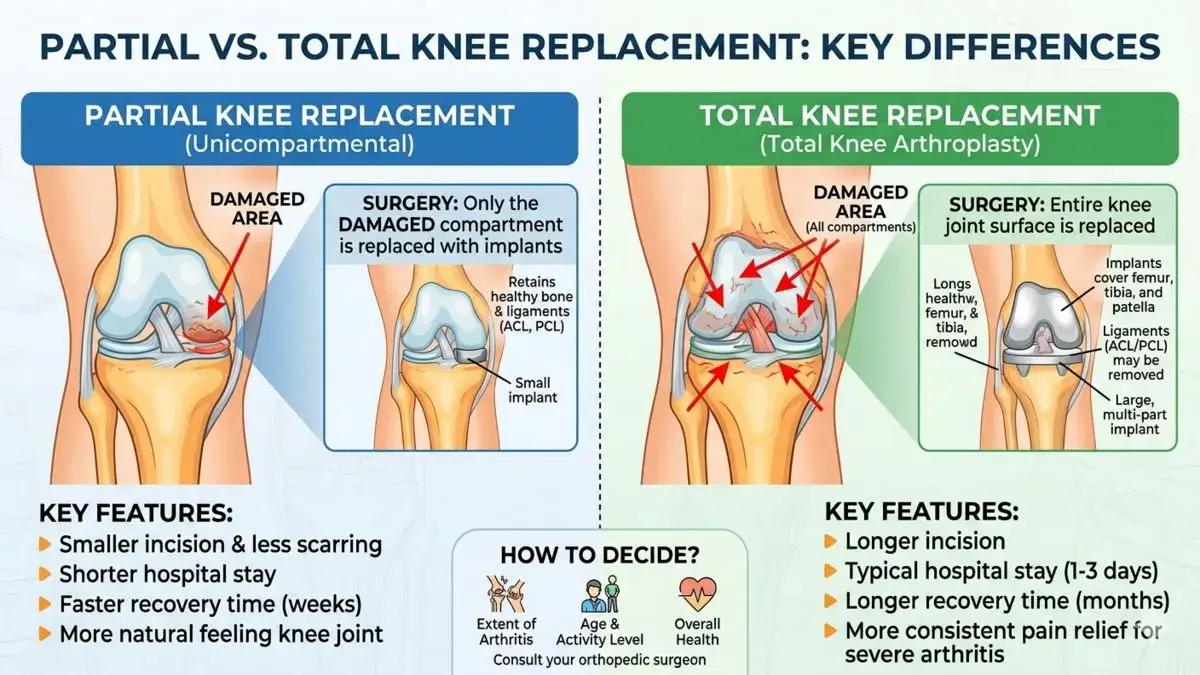
Partial and total knee replacement are surgical options used to treat knee joint damage, commonly from osteoarthritis. Both procedures involve replacing damaged bone and cartilage with artificial components, but they differ in how much of the knee is replaced.
The suitable option depends on the location and severity of knee damage, symptoms, knee stability, age, activity level, medical history, and the orthopaedic surgeon’s assessment.
Table of Contents
What Is Knee Replacement Surgery?
Knee replacement, also called knee arthroplasty, involves removing damaged bone and cartilage from the knee and replacing them with metal and plastic components. It may be considered when knee pain, stiffness, and reduced function continue despite non-surgical treatment.
Before recommending surgery, an orthopaedic surgeon usually assesses knee movement, stability, strength, and imaging findings such as X-rays. X-rays can help show the extent of knee damage before deciding whether knee replacement is appropriate.
What Is Partial Knee Replacement?
Partial knee replacement, also known as unicompartmental knee replacement, replaces only the damaged compartment of the knee. The knee has three main compartments:
- Medial compartment: inner side of the knee
- Lateral compartment: outer side of the knee
- Patellofemoral compartment: front of the knee, between the kneecap and thighbone
Partial knee replacement may be considered when arthritis or damage is limited to one compartment of the knee.
What Is Total Knee Replacement?
Total knee replacement involves replacing the damaged surfaces across the knee joint. It is usually considered when arthritis or joint damage affects multiple compartments of the knee.
This may be more suitable for patients with widespread cartilage loss, deformity, reduced joint stability, or symptoms affecting several areas of the knee.
Key Differences Between Partial and Total Knee Replacement
| Area | Partial Knee Replacement | Total Knee Replacement |
| Area treated | One damaged compartment | Multiple compartments or the whole knee joint surface |
| Suitability | Selected patients with localised knee damage | Patients with wider joint damage |
| Amount of bone and tissue affected | Usually less bone and tissue are removed | More joint surfaces are replaced |
| Ligament preservation | Some natural knee structures may be preserved | Depends on the implant type and surgical plan |
| Recovery | May involve a shorter early recovery in suitable patients | May require a longer rehabilitation period |
| Future surgery | May require conversion to total knee replacement if arthritis progresses | Revision surgery may be needed if the implant wears or loosens over time |
Suitability: Who May Be Considered?
Partial Knee Replacement May Be Considered If:
- Knee damage is limited to one compartment
- Knee ligaments are functioning adequately
- Knee alignment is suitable
- Symptoms match the affected compartment
- There is no widespread inflammatory arthritis
- The patient meets clinical and imaging criteria
Partial knee replacement is not suitable for everyone. Only about 10% to 15% of patients assessed for possible knee replacement are candidates for partial knee replacement.
Total Knee Replacement May Be Considered If:
- Arthritis affects multiple knee compartments
- Pain is widespread across the knee
- There is notable stiffness or deformity
- Knee function is reduced despite non-surgical care
- Imaging shows broader joint damage
- The knee has instability or alignment concerns
Many patients have damage in two or more areas, making total knee replacement the more appropriate option for those cases.
Recovery Differences
Recovery varies from patient to patient. Factors such as age, general health, muscle strength, pain level, and rehabilitation participation can affect progress.
Partial knee replacement may allow a shorter hospital stay and early recovery for suitable patients. Partial knee replacement may involve less time in hospital compared with total knee replacement.
Total knee replacement may involve a longer rehabilitation period because more of the knee joint is replaced. However, both procedures usually require physiotherapy, walking practice, wound care, swelling control, and follow-up appointments.
Benefits and Limitations
Partial Knee Replacement
Possible considerations include:
- Treats only the damaged compartment
- May preserve more natural knee structures
- May involve a shorter early recovery in suitable patients
- May not be suitable if arthritis affects more than one compartment
- Arthritis may later develop in other areas of the knee
Total Knee Replacement
Possible considerations include:
- Treats wider knee joint damage
- May be suitable for patients with multi-compartment arthritis
- May address deformity or broader joint wear
- Recovery may take longer
- As with any surgery, there are risks such as infection, stiffness, blood clots, implant-related issues, or need for future revision surgery
How Doctors Decide Between Partial and Total Knee Replacement
An orthopaedic assessment may include:
- Symptom history
- Physical examination
- Walking and alignment assessment
- Knee stability testing
- X-rays
- MRI or other imaging if needed
- Review of previous treatments
The decision is based on whether knee damage is localised or widespread, whether the ligaments are stable, and whether the patient’s symptoms match the imaging findings.
Questions to Ask Your Orthopaedic Surgeon
Patients may consider asking:
- Is my knee damage limited to one compartment?
- Am I suitable for partial knee replacement?
- Would total knee replacement be more appropriate for my condition?
- What are the risks of each option?
- What recovery timeline should I expect?
- Will I need physiotherapy after surgery?
- What activities should I avoid after surgery?
- How long may the implant last?
- What symptoms should urgent review after surgery prompt?


Bebasinindo: Championing Freedom in Indonesia

Ankwave: Future of Connectivity with Energy-Efficient Solutions

Afruimwagens: Efficient Mobile Carts for Workspaces

Understanding Formula 1 Standings and Championship Rankings

Do Cats Fart? A Scientific and Behavioral Look at Feline Gas

Hatha Yoga: Balancing Body, Mind, and Energy

Wave_of_Happy_: Cultivating a Positive Mindset for Lasting Joy

Gamer Challenger: Definition, Role, and Competitive Focus

Slope Unblocked: Free Online 3D Ball Running Game

Brand Name Normalization Rules: A Complete Practical Guide

Veneajelu: The Finnish Art of Peaceful Summer Boating

The Journey of iamnobody89757: From Anonymous User to Internet Sensation

Adsy.pw/hb3: The Future of High-Impact Digital Advertising

Soutaipasu: Understanding Relative Paths in Computing

Omaha, Nebraska Mental Health Routines for School, Work, and Changing Seasons
-
 GENERAL1 year ago
Christofle – For Those Who Dream of Family Heirloom Silver
-
GENERAL9 months ago
Uncovering the World of кинокрадко: The Dark Side of Film Piracy
-
SPORTS2 months ago
Discover the World of Football with Streameast: Watch Your Favorite Leagues and Tournaments
-
HOME IMPROVEMENT2 years ago
Spacious and Stylish 300cm Round Rugs: Elegant and Modern Designs for a Chic Home Decor