
GENERAL
OTI IAS: Modern UPSC Preparation Competency Model

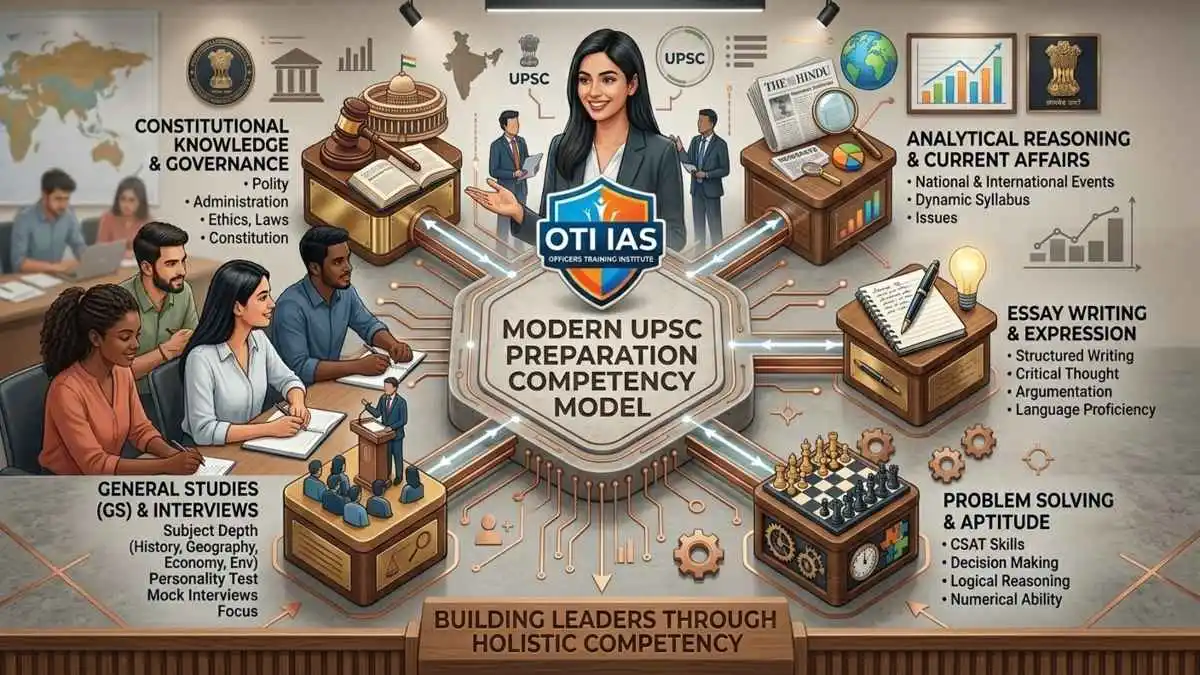
The Union Public Service Commission (UPSC) Civil Services Examination is no longer just a test of knowledge; it has become a test of applied intelligence, analytical reasoning, structured answer writing, and decision-making under ambiguity. Yet, most aspirants still prepare using an outdated model: static notes, repetitive coaching lectures, and memorization-heavy revision cycles.
This is exactly where OTI IAS changes the equation.
Instead of treating UPSC preparation as a content-consumption exercise, it reframes it as a competency-building system, much like how elite institutions train civil servants globally, focusing on skills rather than just syllabus coverage.
Table of Contents
What Makes OTI IAS Different from Traditional UPSC Coaching?
Most UPSC platforms operate on a simple model:
Lecture → Notes → Test Series → Revision → Repeat
This model assumes that knowledge accumulation automatically translates into exam performance. But UPSC toppers consistently demonstrate a different pattern: they don’t just “know more”; they process better.
The OTI IAS framework is built around this insight.
Instead of syllabus-first teaching, it uses a competency-first architecture, where each topic is mapped to a measurable skill outcome:
- Analytical thinking (Policy interpretation, governance reasoning)
- Answer structuring (Introduction–Body–Conclusion clarity)
- Multi-dimensional writing (economic, ethical, historical linkage)
- Current affairs integration (dynamic answer enrichment)
- Elimination-based MCQ reasoning (Prelims accuracy optimization)
This shifts preparation from passive learning to performance engineering.
The Core Architecture of the OTI IAS Competency Model
A key strength of the OTI IAS approach lies in its layered design. It does not treat UPSC as a single exam but as a stack of cognitive competencies.
1. Knowledge Layer (What to Learn)
This is the foundational layer but not the dominant one. It includes:
- Static syllabus (GS 1–4, Optional subjects)
- NCERT-to-advanced progression mapping
- Current affairs integration modules
However, unlike traditional coaching, content is not delivered as bulk notes. It is segmented into micro-concepts tied to exam outcomes.
Example:
Instead of “Indian Constitution – Fundamental Rights,” learners are trained on:
- How to use Article 21 in governance answers
- How to link FRs with Supreme Court judgments in GS2 answers
- How to apply FR logic in ethics case studies
2. Skill Layer (How to Apply Knowledge)
This is where most aspirants fail in UPSC.
The OTI IAS model emphasizes:
- Answer writing frameworks (not just answers)
- Argument structuring under time pressure
- Comparative analysis (India vs global models)
- Ethics decision matrices for case studies
Think of this as the difference between:
- Knowing cricket rules vs
- Playing under match pressure with strategy
3. Performance Layer (How to Improve Continuously)
This is the most important layer and is often missing in conventional coaching.
OTI IAS introduces a feedback loop system, where every test or answer is evaluated on:
- Concept accuracy
- Depth of analysis
- Structural clarity
- Relevance to the demand of the question
- Time efficiency
Instead of marks alone, aspirants receive competency scores, which identify weak cognitive domains.
Why UPSC Aspirants Fail Without Competency-Based Learning
Research across competitive exam ecosystems shows a consistent trend:
70–80% of aspirants fail not due to lack of content, but due to poor application skills.
The core issues include:
1. Over-Information Problem
Students collect excessive notes but cannot prioritize what matters in the exam hall.
2. Static Thinking Pattern
UPSC requires dynamic interpretation of current affairs, not memorized answers.
3. Weak Answer Structuring
Even correct content loses marks when poorly structured.
4. Lack of Feedback Intelligence
Most coaching institutes give marks but not diagnostic feedback.
The OTI IAS framework directly targets these gaps by embedding structured thinking into the preparation process itself.
FAQs
1. Is OTI IAS only for beginners or advanced aspirants?
OTI IAS is designed as a scalable system. Beginners benefit from structured foundations, while advanced aspirants use it to optimize performance and refine answers.
2. How does OTI IAS improve UPSC answer writing?
breaks answer writing into measurable components:
Introduction framing techniques
Body argument layering (multi-dimensional approach)
Ethical and administrative linkage
Conclusion synthesis methods
Instead of memorizing model answers, aspirants learn repeatable writing systems.
3. Does competency-based learning improve UPSC results?
Yes, because UPSC evaluates application of knowledge, not reproduction. Competency-based systems align directly with exam evaluation patterns, especially in GS papers and Essay.
4. How is OTI IAS different from test series programs?
Traditional test series measure performance. OTI IAS measures why performance happens. It identifies whether failure is due to:
Concept gap
Analytical weakness
Writing structure issue
Time mismanagement
This improves targeting rather than relying on randomness.
Real-World Application: How a Topic is Taught in OTI IAS
Let’s take a real example: Disaster Management (GS3)
Traditional Coaching Approach:
- Lecture on types of disasters
- Static notes on NDMA guidelines
- 10–15 model answers
OTI IAS Competency Approach:
- Scenario-based disaster simulation questions
- Integration with climate change policy
- Real-time application (recent floods, earthquakes)
- Answer writing under timed pressure with structured rubric feedback
Result: The aspirant doesn’t just know disaster management; they learn how to think like a district administrator during crisis response.

The Hidden Advantage
One of the most overlooked aspects of UPSC preparation is cognitive conditioning under pressure.
OTI IAS indirectly trains:
- Decision speed under uncertainty
- Prioritization of information in MCQs
- Mental structuring of long-form answers in 7–8 minutes
- Emotional stability during mock evaluation cycles
This mirrors real UPSC conditions more accurately than content-heavy coaching systems.
Why the Future of UPSC Prep is Competency-Based
The UPSC examination pattern has evolved significantly over the last decade:
- Increased analytical questions in Prelims
- Greater integration of current affairs in Mains
- Emphasis on governance and ethical reasoning
- Reduced predictability in question patterns
This means:
“Content memorization alone is no longer a competitive advantage.”
Systems like OTI IAS represent a shift toward performance engineering in education, where the goal is not teaching subjects, but building civil service capabilities.
Globally, this mirrors how:
- Medical education focuses on clinical competencies
- Aviation training focuses on simulation hours
- Military training focuses on scenario-based execution
UPSC preparation is slowly moving in the same direction.
Strategic Takeaway for Aspirants
If we strip everything down, the core insight is simple:
Success in UPSC is no longer about how much you study, but how effectively you convert knowledge into structured answers under pressure.
OTI IAS builds this bridge between:
- Knowledge → Application
- Preparation → Performance
- Learning → Execution
That bridge is exactly what most aspirants lack.


Lizard Pose: A Complete Guide to Form & Flexibility

Dermatologist: Why This Specialist Matters for Your Skin Health

How AI Is Reshaping the Way We Edit Video

Tech Etruesports: The Evolution of Competitive Gaming

Ceıvır: Traditional Turkish Dish with Rich Flavors

GNHUSTGames: The Ultimate Platform for Unblocked Games

Kraams: The Heart of Dutch Market Culture

Butterfly Position: How to Do Baddha Konasana Safely

Tissariss Textile Art: A Tradition of Cultural Weaving

Anna Archive: Free Shadow Library Search Engine

Bl_Faceless: Anonymous Digital Creators Redefining the Digital Space

Pepe Coin Overview: Inside the Meme Cryptocurrency Craze

Lotus Position (Padmasana): How to Do It Safely and Avoid Knee Pain

How to Prepare for a Gynaecology Appointment

RPDJAFUD: The Future of AI-Driven Cybersecurity and Automation
-
 GENERAL1 year ago
Christofle – For Those Who Dream of Family Heirloom Silver
-
SPORTS1 month ago
Discover the World of Football with Streameast: Watch Your Favorite Leagues and Tournaments
-
HOME IMPROVEMENT1 year ago
Spacious and Stylish 300cm Round Rugs: Elegant and Modern Designs for a Chic Home Decor
-
GENERAL9 months ago
Uncovering the World of кинокрадко: The Dark Side of Film Piracy