GENERAL
Messeregge: Precision Blade Harrow for Shallow Cultivation

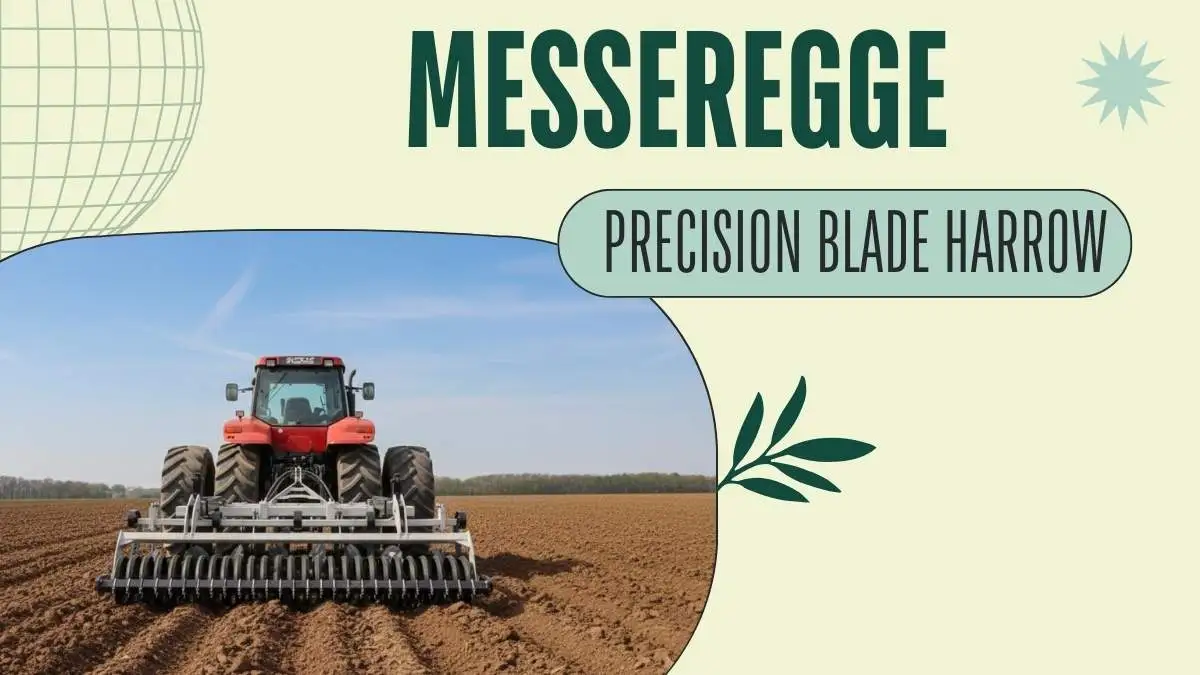
A Messeregge is a tillage implement equipped with multiple narrow, blade-shaped steel knives mounted on a rigid or semi-flexible frame. These blades work at shallow depths, typically between 2 and 6 centimeters, cutting through crop residues and lightly disturbing the soil surface without inverting soil layers.
Unlike conventional plows or deep cultivators, the Messeregge focuses on horizontal cutting action rather than vertical soil turnover. This design allows it to achieve uniform surface cultivation while preserving subsurface soil structure.
Table of Contents
Historical Development and Agricultural Context
The Messeregge originated in European agricultural systems where soil conservation and energy efficiency became priorities earlier due to regulatory, environmental, and land-use pressures. Its adoption expanded alongside the development of minimum tillage, reduced tillage, and conservation agriculture practices.
Historically, deep plowing was considered essential for weed control and seedbed preparation. However, long-term research demonstrated that excessive soil disturbance can degrade soil structure, accelerate erosion, and reduce organic matter. The Messeregge emerged as a response to these challenges, offering a more controlled and surface-oriented approach to soil management.
Design and Working Principle
Blade Configuration
The defining feature of a Messeregge is its knife-like blades, arranged in rows across the working width. These blades are:
- Narrow and sharp-edged
- Spaced to ensure full surface coverage
- Mounted at precise angles to optimize cutting efficiency
This configuration allows the implement to slice through residues and soil aggregates rather than lifting or turning them.
Operating Depth
It is specifically engineered for shallow cultivation. Operating at minimal depths helps:
- Avoid disruption of soil horizons
- Protect beneficial soil microorganisms
- Maintain capillary water movement
This shallow action is particularly valuable in fragile or erosion-prone soils.
Primary Agricultural Applications
Seedbed Preparation
One of its main uses is to create a fine, level seedbed. By breaking surface crusts and leveling micro-unevenness, it improves seed-to-soil contact without excessive loosening.
Crop Residue Management
The Messeregge effectively cuts and distributes crop residues such as straw or stubble. This uniform residue distribution supports:
- Improved decomposition
- Enhanced soil organic matter cycling
- Reduced pest and disease carryover
Weed Control at Early Stages
While not a replacement for integrated weed management, the Messeregge can mechanically disrupt young weeds during early growth stages, particularly in reduced-chemical or organic systems.

Role in Conservation and Minimum Tillage Systems
The Messeregge is widely recognized as a compatible tool for conservation agriculture, which is based on three core principles:
- Minimal soil disturbance
- Permanent soil cover
- Crop rotation
By working only the soil surface, it aligns closely with these principles. It limits erosion risk, maintains soil aggregates, and supports long-term soil fertility.
Soil Health and Agronomic Benefits
Preservation of Soil Structure
Because the Messeregge avoids deep soil inversion, it helps maintain:
- Stable soil aggregates
- Natural pore networks
- Root channels from previous crops
This structural preservation enhances root development and nutrient uptake.
Moisture Retention
Shallow cultivation reduces evaporation by maintaining residue cover and intact soil layers. This is particularly beneficial in semi-arid and drought-prone regions, where moisture conservation is critical.
Reduced Compaction Risk
Compared to heavier tillage equipment, Messeregge operations require lower tractor power and result in reduced axle load stress on the soil, minimizing compaction in the root zone.
Energy Efficiency and Operational Advantages
From an operational standpoint, the messeregge is valued for its low energy requirement. Shallow working depth and efficient blade design reduce draft force, leading to:
- Lower fuel consumption
- Reduced greenhouse gas emissions
- Increased field efficiency per hour
These characteristics make it suitable for farms aiming to balance productivity with environmental responsibility.
Comparison with Other Shallow Cultivation Tools
| Feature / Implement | Messeregge (Blade Harrow) | Disc Harrow | Tine Harrow |
| Primary Action | Slicing / cutting | Cutting + mixing | Lifting / raking |
| Soil Disturbance | Minimal / surface-level | Moderate / mixes top layers | Light to moderate |
| Residue Handling | Excellent slicing & distribution | Can bury residue | May leave residue uneven |
| Energy Requirement | Low | Moderate to high | Low |
| Best Use | Seedbed prep, conservation agriculture | Seedbed prep in conventional tillage | Light weed control, leveling |
Limitations and Considerations
Despite its advantages, the Messeregge is not universally applicable. It may be less effective:
- In heavily compacted soils requiring deep loosening
- For controlling perennial weeds with deep root systems
- As a standalone tool in high-residue conditions without complementary equipment
Understanding these limitations is essential for integrating it effectively into a broader soil management strategy.
The Messeregge in Modern Sustainable Farming
As agriculture faces increasing pressure to reduce environmental impact while maintaining yields, tools like the Messeregge represent a shift toward precision-based, knowledge-driven farming. Its use reflects a growing recognition that soil is a living system requiring careful management rather than aggressive manipulation.
By supporting soil health, conserving resources, and improving operational efficiency, it continues to play a meaningful role in modern agricultural practices.
FAQs
1. Can a Messeregge be used in wet soil conditions?
It performs best in moderately dry to moist soils. Excessively wet soils may cause clogging of blades and uneven slicing, reducing efficiency.
2. How does the Messeregge affect soil microbial activity?
Since it only lightly disturbs the topsoil, it preserves microbial habitats and supports healthy soil microbiomes, promoting nutrient cycling and organic matter decomposition.
3. Is the Messeregge suitable for all crop types?
While versatile, it is most effective for cereals, legumes, and small-seed crops. Deep-rooted perennial crops or heavy residue conditions may require complementary implements.
Conclusion
The Messeregge is more than a simple tillage implement; it reflects evolving agricultural priorities. Designed for shallow, precise soil cultivation, it enables farmers to prepare seedbeds, manage residues, and support conservation goals without compromising soil integrity. While not a universal solution, its strategic use within minimum tillage systems offers measurable agronomic and environmental benefits.


Messeregge: Precision Blade Harrow for Shallow Cultivation

Eco-Friendly Recirculating Cooker Hoods for Sustainable Kitchens

AHGRL in AI: Scalable Graph-Based Reinforcement Learning

Do a Barrel Roll: Iconic Gaming Phrase and Google Trick

Google Doodle Today: Culture, History, and Innovation

Slylar Box: Modular & Smart Storage for Modern Spaces

Video&A: Boost Engagement with Interactive Video Content

Sodziu: Heart of Traditional Lithuanian Countryside

Why Consistent Cleaning Is Essential for Chicago Apartments

Common Surgical Applications of DHS/DCS Plate Systems

Why Leather Floggers Are Popular Among Women

Dechecker AI Checker: Writing That Holds Up Under Real Review

Recyclatanteil: Measuring the Share of Recycled Material

Walking Yoga: A Blend of Movement and Mindfulness

Sumosearch: AI-Driven Search Engine
-
 GENERAL8 months ago
Christofle – For Those Who Dream of Family Heirloom Silver
-
SPORTS10 months ago
Discover the World of Football with Streameast: Watch Your Favorite Leagues and Tournaments
-
GENERAL1 month ago
Uncovering the World of кинокрадко: The Dark Side of Film Piracy
-
GENERAL4 months ago
ATFBooru: Anime, Gaming, and Subculture Imageboard