
GENERAL
Brand Name Normalization Rules: A Complete Practical Guide


Brand name normalization is the process of standardizing how a brand name is written, stored, and used across digital and offline systems. It involves defining rules for spelling, capitalization, abbreviations, punctuation, and representation to eliminate variations such as “IBM,” “I.B.M.,” and “International Business Machines” that appear inconsistently across data sources. Brand name normalization rules ensure that a brand’s identity is represented uniformly across systems, platforms, and user interactions.
Table of Contents
Why Brand Name Normalization Matters
1. Enhances Search Accuracy
When brand names are standardized, search systems, including internal search engines and third-party platforms, can retrieve results more reliably. Users searching for a brand encounter a consistent match, improving relevance and reducing false negatives.
2. Improves Data Quality and Analytics
In business intelligence and analytics, inconsistent naming leads to fragmented datasets. Normalizing brand names ensures that performance metrics, customer behavior analysis, and reporting reflect accurate, consolidated data.
3. Supports SEO and Digital Visibility
Search engine algorithms analyze textual entities to understand content context. Consistent brand naming assists in entity recognition, helping algorithms correctly associate content with the intended brand. This enhances search engine visibility and reduces misinterpretations caused by variant spellings.
Key Principles of Brand Name Normalization Rules
1. Establish a Canonical Form
A canonical name is the authoritative, standardized version of a brand name. Organizations should document this preferred form and communicate it to all stakeholders. For example:
- Canonical: Acme Corporation
- Disallowed: acme corp., ACME CORP, Acme Co.
The canonical form should be used in all official assets, metadata, and structured data.
2. Define Capitalization Standards
Capitalization rules ensure that brand names are consistently presented. This often involves declaring:
- Title case (e.g., First Choice Foods)
- Uppercase acronyms (e.g., NASA)
- Exceptions for stylized brand elements
Clear capitalization standards reduce visual inconsistency and support brand recognition.
3. Address Punctuation and Abbreviations
Brand names sometimes include punctuation or abbreviations (e.g., hyphens, ampersands). Normalization rules should specify how these are handled across systems.
Examples:
- Use “&” vs. “and.”
- Remove punctuation only if it interferes with system processing
- Standardize abbreviations like “Intl.” or “Corp.”
This ensures that variants such as “Pro-Tech Solutions,” “Pro Tech Solutions,” and “ProTech Solutions” are reconciled under a single normalized name.
4. Incorporate Internationalization Rules
Global brands must consider localization and translation norms. Normalization rules should outline:
- How to retain brand integrity in different languages
- When to translate brand descriptions vs. keeping the brand name intact
- Handling diacritics and special characters
These guidelines help maintain consistency in multilingual content without compromising readability.
Brand Name Normalization in Technical Systems
In databases and software applications, normalization involves technical considerations that align with data architecture best practices.
Database Normalization for Brand Names
Within relational databases, normalization rules help prevent duplicate records and ensure referential integrity. Typical practices include:
- Storing the canonical name in a primary table
- Using foreign keys to link references
- Avoiding free-text brand references in transactional data
This layer of normalization complements the editorial rules applied to content.
Normalization in Content Management Systems (CMS)
CMS platforms often require governance to maintain brand naming standards. Good practices include:
- Using predefined taxonomy and controlled vocabularies
- Enforcing naming rules in content templates
- Conducting periodic audits for compliance
Automation tools and plugins can flag deviations from normalization standards during content creation.
Brand Name Normalization and SEO
While brand name normalization is fundamentally about consistency, it also intersects with search science.
Entity Recognition and Keyword Mapping
Search engines increasingly rely on entity recognition to understand content context. A normalized brand name becomes a stable reference point that search algorithms can associate with a real-world organization or product.
Normalization helps with:
- Mapping related search queries
- Reducing confusion from variant terms
- Strengthening brand relevance signals
Avoiding Normalization Pitfalls
Over-normalization, such as artificially altering brand names to boost keyword density, can misrepresent the brand and violate search engine guidelines. Instead, normalization should reflect the brand’s true, naturally used forms.
For example, artificially inserting hyphenated keywords or keyword stuffing around the brand name undermines trust and harms readability.
Governance and Implementation of Normalization Rules
Establishing normalization rules is only the first step. Successful implementation requires governance, monitoring, and stakeholder alignment.
1. Create a Naming Standards Document
Document normalization rules clearly and share them across:
- Marketing teams
- Content creators and editors
- Web developers
- Database administrators
Include examples, exceptions, and use cases.
2. Train Contributors
Educate internal teams on applying naming rules during content production, system design, and data entry. This reduces errors before they propagate.
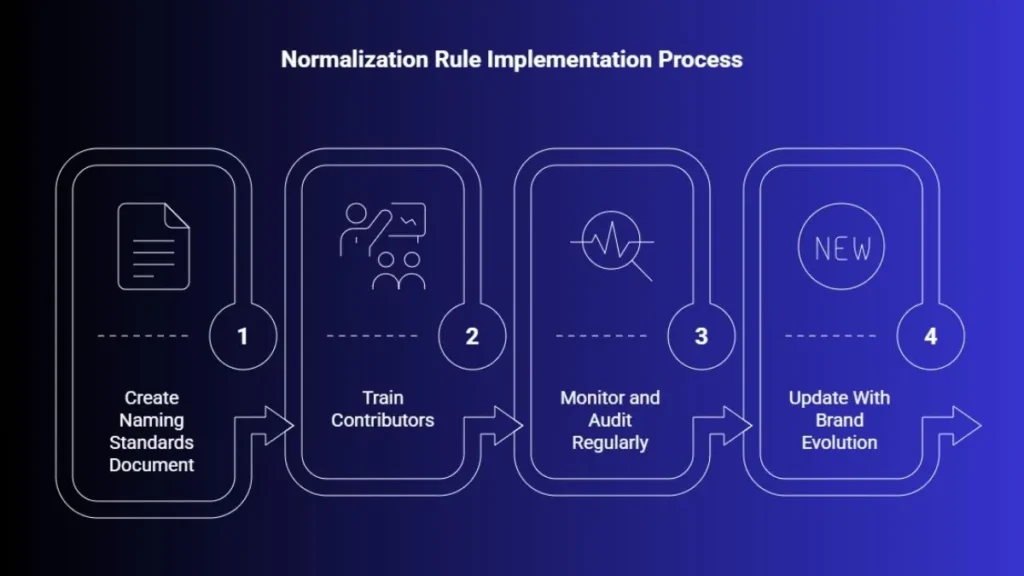
3. Monitor and Audit Regularly
Normalization is an ongoing process. Regular audits help identify:
- Outdated variants
- System exceptions
- Unintentional deviations
Use automated tools where possible to scan for inconsistencies.
4. Update With Brand Evolution
As brands evolve (new products, rebranding, mergers), normalization rules should be revisited. The canonical form may change, and all associated systems must adapt.
Case Example: Standardizing Brand Names Across Platforms
Imagine an international retail brand with varying representations across its website, partner sites, and customer records. Without normalization:
- Analytics might count “BrandX,” “brand x,” and “BRAND-X” separately
- Search users might struggle to find consistent results
- Legal documents may inadvertently misrepresent trademarks
With brand name normalization rules in place, the organization:
- Defines “BrandX” as the canonical form
- Aligns capitalization and punctuation across systems
- Employs schema markup to communicate the brand to search engines
- Performs regular audits to ensure compliance
The result is improved search accuracy, cleaner data reporting, and stronger brand perception.
FAQs
1. Can brand name normalization rules help prevent duplicate customer profiles in CRM systems?
Yes, consistent brand naming reduces data fragmentation and prevents duplicate or mismatched records in customer databases.
2. Are brand name normalization rules relevant for voice search and AI assistants?
Yes, normalized brand names improve the accuracy with which voice-enabled systems and AI models recognize and respond to brand-related queries.
3. How often should organizations review their brand name normalization rules?
Brand name normalization rules should be reviewed whenever there is a rebrand, merger, or major digital infrastructure update.
Conclusion
Brand name normalization rules are foundational for maintaining consistency, data quality, and clear communication in the digital age. By establishing canonical names, defining formatting standards, and aligning technical systems, organizations can unify brand representation across content, databases, and search platforms.


Master the Fly Pose: A Step-by-Step Guide for Yoga Enthusiasts

Partner Yoga Poses: A Journey of Connection, Trust, and Balance

Unlocking the Healing Power of Tibetan Singing Bowls: A Comprehensive Guide

Kundalini Awakening: Balancing Energy Through Yoga

PPC Marketing for Dentists, How to Write Ad Copy that Matches Real Patient Fears and Wins Clicks

Yalla Choy: Nutritional and Versatile Leafy Green Vegetable

Yoga Exercises: Benefits, Types, and Safe Practice Guide

Black Letterboxes: The Minimalist & Functional Design for Your Front Door

Hospital Cleaning Services: Ensuring Hygiene and Safety in Healthcare Facilities

Solar Plexus Chakra: Meaning, Power, and Inner Confidence

Unlocking the Power of Urdhva Dhanurasana: A Guide to Wheel Pose

8 Health Benefits of Bikram Yoga

Hand Yoga and 6 Poses to Benefits Hands, Fingers and Wrists

Chaturanga Yoga Guide | Strength, Balance & Mindfulness

Chest Opener Stretch: Technique, Benefits, and Best Practices
-
 GENERAL9 months ago
Christofle – For Those Who Dream of Family Heirloom Silver
-
SPORTS11 months ago
Discover the World of Football with Streameast: Watch Your Favorite Leagues and Tournaments
-
GENERAL3 months ago
Uncovering the World of кинокрадко: The Dark Side of Film Piracy
-
GENERAL5 months ago
ATFBooru: Anime, Gaming, and Subculture Imageboard